












Honors Alumni
We are always interested in hearing from Honors College alums. Please send us an update by email or by completing and sending our biographical update sheet (PDF). Pictures are a welcome addition!
==========================
Honors Alum and WSU Regent, Bill Marler, in the News.
Source: King County Bar Association, Bar Bulletin, November 2005
Bill Marler
- Education Holds Key in Tainted-Food Fight
By Ross Anderson
When Wyoming public health workers convened at a Cody meeting room recently, they spent much of three days listening to various authorities bring them up to date on issues ranging from prenatal care to septic tanks to bio-terrorism. But the keynote address did not come from a physician; it was delivered by a lawyer.
“Chasing ambulances is only part of what I do,” Bill Marler told the crowd, drawing a ripple of chuckles across the room of about 125 people.
“I represent people who are some of the most vulnerable in our society -- kids who face a lifetime of kidney damage and possible transplants, all because they ate an undercooked hamburger.”
And he wanted his cattle country audience to know that he and public health officials are, or should be, on the same side of those issues.
Marler and his Seattle firm, Marler Clark LLP, specialize in representing people sickened by food-borne contaminants that often lead to excruciating and sometimes fatal disorders caused by toxins such as E. coli O157:H7 and Salmonella. In the past decade, the firm has won more than $200 million in judgments and settlements from corporate giants across the United States.
And yet, as Marler travels the country for his clients, he makes frequent stops at hotel meeting rooms to talk--at no charge--to public health departments, environmental health associations and trade groups for the restaurant, supermarket and meat-processing industries.
His basic message: Make my day. Take the logical, common-sense precautions, he says, and this society can virtually eliminate food-borne illness, and therefore the lawyers who are associated with it. Put me out of business, please.
It is an unexpected message, coming from an unusual lawyer.
A Washington native, Marler studied at Washington State University and the Seattle University Law School. “I hated law school,” he told his Wyoming audience. “It weeds the wrong people out of the profession. It almost weeded me out.”
As a 19-year-old student at WSU, Marler discovered his penchant for politics, running successfully for the Pullman City Council in 1977. That experience provided an early lesson -- that law and politics are inseparable: one can’t succeed in one without at least understanding, and preferably indulging in, the other.
After several years of trial work in Seattle, Marler’s big break came in 1993 when the San Diego-based Jack in the Box chain was caught up in an outbreak of E. coli O157:H7, the notorious toxin that travels in the intestines of certain animals -- especially cows. Marler represented several children, including Brianne Kiner, a Seattle girl who was one of those most critically sickened and who became the poster child of the outbreak.
Marler tracked down evidence that Jack in the Box was undercooking its hamburgers, despite suggestions from its own employees to cook them more thoroughly. Ultimately, he won a staggering $15.6 million settlement for Brianne.
Marler was on his way. He moved his wife, Julie, and daughters, Morgan, Olivia and Sydney, into a waterfront home on Bainbridge Island. He indulged his taste for a good Cuban cigar and single-malt scotch. He set up his own firm in the Bank of America Tower along with two former adversaries from the Jack in the Box case: attorneys Bruce Clark and Denis Stearns. He took on one corporate food chain after another, including Costco, Kentucky Fried Chicken, McDonald’s, Sizzler, Hardee’s and Wendy’s, winning seven- and eight-figure settlements and verdicts for his young clients.
But Marler decided early on that he would rather succeed without having to see “five-year-old kids hooked up to kidney dialysis machines, dying slow and painful deaths--just because Mom bought them a hamburger. It didn’t make sense. Somebody has to make these companies accountable for the food they serve to innocent people.”
When necessary, Marler found he could apply pressure by working with the media. “But it wasn’t fast enough,” he says. “There were still too many kids getting sick.”
So he founded Outbreak, Inc., a not-for-profit organization housed in Marler Clark’s 66th-floor law offices. Outbreak, Inc. provides resources to health workers and companies that want to train their employees on how to avoid E. coli and other food-borne illnesses. Marler estimates that he has spoken to groups of public health officials in 20 states, from New York to Florida to California, and that he has spoken at as many as 50 food-industry meetings. He was the recent keynote speaker at a national Centers for Disease Control conference.
At the same time, he became a major contributor--in time and money--to an advocacy group called Safe Tables Our Priority, or STOP.
He has become a powerful voice in state and national politics, raising money for former Washington Gov. Gary Locke and holding fundraisers for a wide range of state and national candidates. He even considered running for Congress himself, but eventually figured he could be more effective as a lawyer than as a politician.
His speaking engagements around the country serve multiple purposes, Marler says. Each meeting with public health officials helps foster cooperation with the health bureaucracy, cooperation that may eventually pay off when he needs inspection reports or other documents to make a case for his clients. And he makes potentially helpful contacts with people who may later help his clients.
But it is mostly about preventing children from getting sick, he says.
“Health department personnel and environmental health professionals are unclear about how what they do fits with what I do,” he says. “They worry about being sued for something they do or for something they don’t do. And I try to dispel that fear.”
At the Wyoming meeting, he explained that personal injury lawyers come to health departments for information to use against manufacturers, processors and restaurants, not health departments. He carefully explained legal concepts such as strict liability, negligence and punitive damages -- all familiar terms to lawyers but not so familiar terms to those in the health and food-service communities. All apply to restaurants and other manufacturers of food products when an outbreak of food-borne illness hits.
The bottom line, he told his Wyoming audience, is this: “You have virtually zero chance of being sued for your inspections. So do your job and do it well. Your clientele includes the food service industry and its customers. And they need to understand food-borne illness. So educate, educate, educate.”
Health officials are usually more responsive to his message than the food industry, Marler says. “Some people don’t want to hear what I have to say. When I meet with them, they don’t know if I’m Daniel in the lion’s den or the fox in the henhouse.”
But Marler continues to seek out opportunities to advise companies on how to keep their customers healthy and, in turn, to keep him from suing them.
“I want to be feared by my opponents, but I also want to be respected,” Marler says. “I believe that doing what I do, and doing it well, has influenced the food industry. And I hope that means fewer kids are getting sick.”
Since the series of costly and highly publicized food poisoning outbreaks in the 1990s, there has been a marked decline in the incidence of E. coli O157:H7, he says. The last major outbreak involving ground beef was in 2002.
“I don’t take all the credit for that,” he says, “but I have to guess that taking $200 million from the food industry and going out and talking to these trade groups has raised awareness in these companies.”
So, is he putting himself out of business? To visit his Seattle office, you might think so. On a typical day, Marler and his colleagues are likely to be found working in shorts and T-shirts or eating take-out sandwiches at a conference table with a fire crackling on the built-in TV screen. His journey to Cody included a day of fly-fishing on the Shoshone River.
But, unfortunately for the consuming public there has been no shortage of food-borne illness cases. Marler still has his hands full with outbreaks of Salmonella, Listeria, hepatitis A and other food-borne pathogens. He travels nearly every week back and forth across the country “spreading the word and litigating where necessary.”
“E. coli used to be the majority of our business, but these other bugs have filled the gap pretty well,” he says.
==========================
Honors College Homecoming Open House – Third Annual
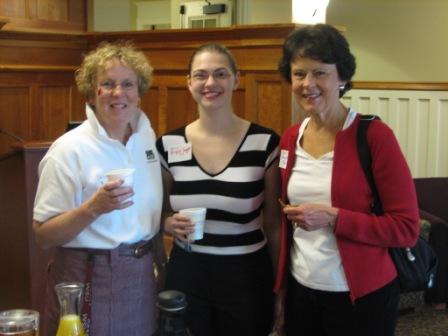
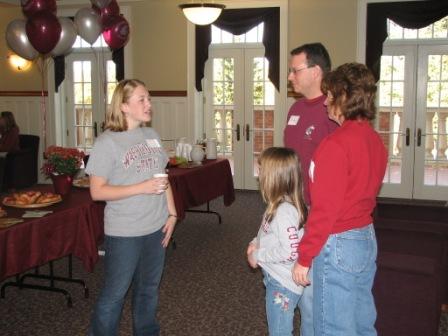
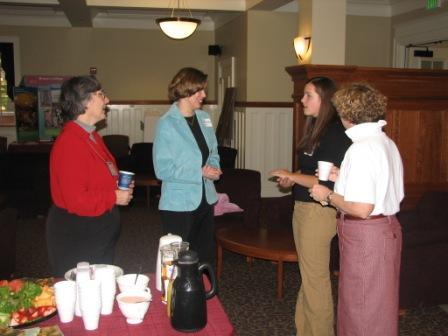
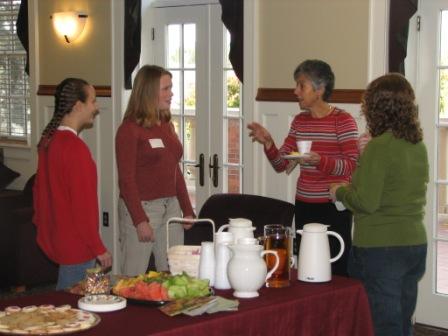
Crimson and gray balloons, current students and families, building tours, mini-course “Honors 101”, donut holes, Honors College Advisory Council, faculty and staff, cookies, student volunteers, and, of course, Honors College grads and friends made up a terrific Cougar event in Honors Hall on Saturday, October 15th.
It was an opportunity to meet, greet, and share stories about Honors College experiences right now and way back when. From ”remember the time in Bryan Hall when we......” to “tell us about being an Honors student in 2005.” Students present and past agreed that their educational experiences in the Honors College were and continue to be transformational – the things that open eyes and minds to the possibilities that exist for undergraduates.
Mark your calendar
for our Open House 2006, Saturday, October 14th.
==========================
Salmon Bake Scholarship Fireside Gathering
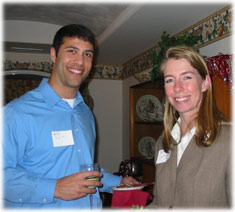 Honors
College friends and alums were invited to a Salmon Bake Scholarship Fireside
Gathering at the home of Harold and Sheila Brunstad in Camas, Washington.
Peter Bhatia, Executive Editor of The Oregonian, and Scott Keeney, President/CEO
of nLight, addressed the Honors College emphasis of "Graduating Students
with a Global Perspective." Thanks to Harold and Sheila for sharing
their home and to all of our guests who attended this very informative
event.
Honors
College friends and alums were invited to a Salmon Bake Scholarship Fireside
Gathering at the home of Harold and Sheila Brunstad in Camas, Washington.
Peter Bhatia, Executive Editor of The Oregonian, and Scott Keeney, President/CEO
of nLight, addressed the Honors College emphasis of "Graduating Students
with a Global Perspective." Thanks to Harold and Sheila for sharing
their home and to all of our guests who attended this very informative
event.
Ian McNickle and Tammy Turner
==========================
 Jake Nonis in his classroom. |
Jake Nonis
Makes his Mark Teaching High School Math
I began
teaching at Newport High School in September of 2004. I soon discovered
the constructivist approach to teaching was taking up much of the class,
and there didn't seem to be enough time to support the various levels
of student learning. My former high school math teacher showed me a simple,
yet powerful idea. Now "Just-in-time" whiteboard movies have
become a staple of my classroom. My students often ask, "Are you
going to make movies for those problems?" as they run from the room
to get to their next class. Of course I know the power these movies create,
so the answer is always "yes."
The idea is simple: record the screen and your voice as you write on a graphics tablet and narrate into a microphone. Use Camtasia Studio screen recording software to change the files into a smaller format and then use it to produce a webpage which completes the process.
I've gotten quite efficient and now can make a set of good movies in the same amount of time it would take to explain the problem to a single student, but now many can watch it multiple times. They can watch it and watch it, and watch it some more if they want. It's like being able to rewind the classroom experience on the computer screen. If the medium isn't right for all students, a set of good movies can be burned to a DVD to be played on the TV screen at home. They don't have to be perfect, but they have to be "just in time" to help students learn the material.
My movies have attracted the attention of the principal and more recently the superintendent of the school district as a technology innovation. I never thought I'd get an e-mail from the superintendent of the school district in my first three months of teaching. This great advancement brings the learning to where most of the students already spend their time - the internet.
Here is a link to
some of my most recent work.
http://www.bsd405.org/teachers/nonisj/unit_1_review/unit_1_review.html
==========================
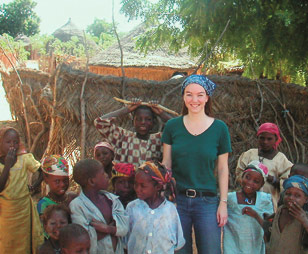 Marissa Lemargie with children in Niamey, Niger |
Marissa
Lemargie Busy Providing Humanitarian Assistance in Africa and South America
Marissa Lemargie tends to take things in on a global scale. Her interest in other cultures and societies led to an anthropology degree at Washington State University in 1999. A master's degree in international development from the London School of Economics and Political Science followed. Lemargie is now employed by USAID as an international cooperation specialist for Colombia and Paraguay in Washington, D.C.
Like her older brother, Kyle ('98 Polit. Sci.), who works for the Smithsonian Institution in Washington, D.C., she was attracted to WSU by the Honors College. In a capstone course in anthropology, Professor Linda Stone shared her experiences teaching Peace Corps volunteers and with development in third-world countries. "That course . . . opened up ideas for me," Lemargie says. She began looking at how access to resources, particularly education and healthcare, profoundly affect people in the world's poorest countries. More>>
==========================
 Briefs
from Baghdad
Briefs
from Baghdad
Elisha Grange ('03, Communications) was a public affairs advisor to the
Iraqi Ministry of Interior in Baghdad, Iraq for six months. Originally
hired by the Department of Defense, she transferred to State Department
during the June 30 government handover. She volunteered to go to Iraq
to put her journalistic ideals to the test and see what the media bias
is like in a war zone. The following are excerpts from her emails sent
to friends and family.
One : Baghdad, July 1, 2004
The media coverage during transition was anticlimactic. Everyone was expecting
massive attacks on June 30th. Then the government suddenly was handed
over two days early and Bremer left the country. If there were any plans
for terror attacks, they fell through with the sudden transition. The
media were left without their bombs and fire stories. They still tried
to fill in the news with what they'd expected, but that meant they were
focusing disproportionate attention on the few small mortar attacks that
did occur. More>>
Contact
us: honors@wsu.edu 509 335-4505 |
Accessibility | Copyright
| Policies
Honors College, PO Box 642012, Washington
State University, Pullman, WA, 99164-2012 USA