












Marissa Lemargie Busy Providing Humanitarian Assistance in Africa and South America
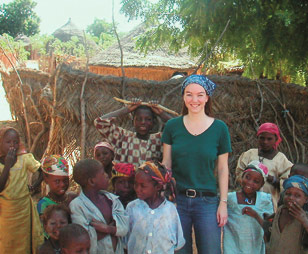 Marissa Lemargie with children in Niamey, Niger |
Marissa Lemargie tends to take things in on a global scale. Her interest in other cultures and societies led to an anthropology degree at Washington State University in 1999. A master's degree in international development from the London School of Economics and Political Science followed. Lemargie is now employed by USAID as an international cooperation specialist for Colombia and Paraguay in Washington, D.C.
Like
her older brother, Kyle ('98 Polit. Sci.), who works for the Smithsonian
Institution in Washington, D.C., she was attracted to WSU by the Honors
College. In a capstone course in anthropology, Professor Linda Stone shared
her experiences teaching Peace Corps volunteers and with development in
third-world countries. "That course . . . opened up ideas for me,"
Lemargie says. She began looking at how access to resources, particularly
education and healthcare, profoundly affect people in the world's poorest
countries.
Lemargie moved from
London to Washington, D.C., in 2000 and began working as a full-time volunteer
at the human rights organization Amnesty International USA. She was part
of an NGO (non-governmental organization) coalition team that helped draft
legislation that later became law prohibiting unregistered diamonds from
entering the U.S. She explained how guerillas in Sierra Leone financed
their rebellion with the sale of diamonds mined by villagers forced into
servitude. The fighting continued through 2002.
After nearly a year with Amnesty International, Lemargie got her government
career break when she was awarded a Presidential Management Fellowship
with the U.S. Department of State, one of only 400 picked annually in
a program designed to attract top graduate students as Civil Service employees.
Over a two-year period, she was placed in three rotations within the federal
government to "get a taste and flavor of the different jobs."She
began work the day before September 11, 2001, and spent her first year
focusing on the humanitarian situation in Afghanistan. Later, she served
six weeks as a U.S. delegate to the United Nations for the Committee on
Program Coordination. She was a member of a panel representing 30 countries.
Delegates were charged with coming to consensus on "what our goals
were in the world for education and health care," she says, and "how
to prioritize different activities for funding."In her second year,
Lemargie was posted to Niger, the poorest Muslim country in Africa, as
political officer for the American Embassy in Niamey. There she focused
on human rights, child labor, people sold against their will into the
slave or prostitution industry, and socio-economic development. It proved
to be one of the most challenging and most inspiring of her assignments
with the State Department. She was particularly impressed with the charisma
of the women in Niger and had the honor of meeting the only female mayor
in the country.Her third rotation was in the USAID's Latin American-Caribbean
Bureau in Washington, D.C. She was assigned to the democracy, governance,
and human rights area and received an award for her efforts to address
trafficking in persons in Latin America. Now a permanent civil servant
with USAID, Lemargie works on humanitarian assistance for Colombia and
Paraguay. With an annual budget of $120 million, the Colombia development
program focuses on "basic democratic reform, internally displaced
persons, and alternative development," she says. Despite being one
of the longest-standing democracies in South America, Colombia has been
in a civil war for 40 years."We are trying to improve the state's
presence throughout the country," Lemargie says, "to assure
the people that they have access to government services and some sense
of security."Discussions are currently underway between the government
of Colombia and the paramilitaries to negotiate a peace agreement. Lemargie
is enthusiastic about what is being accomplished in the debates around
the issue in the nation's capital. Regarding her role in helping to prepare
senior officials for these issues, she says, "I feel like I am finally
getting into a position where I am able to influence some of the discussion."
Contact
us: honors@wsu.edu 509 335-4505 |
Accessibility | Copyright
| Policies
Honors College, PO Box 642012, Washington
State University, Pullman, WA, 99164-2012 USA