












Lauren Carter Conducts Research in the Seychelles
Spending a summer
in a tropical paradise 1000 miles away from anywhere is nothing short
of an 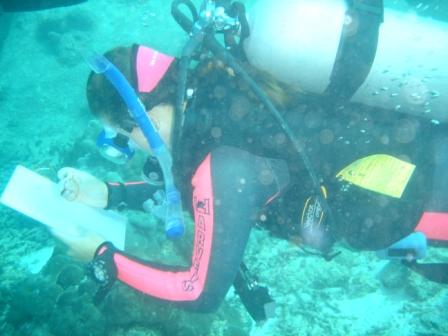 amazing
experience. During the summer of 2005, I was in the Seychelles, a small
archipelago nation of over 100 islands, just 4 degrees south of the equator,
studying coral reefs. I was the youngest of 16 volunteers, and one of
only two Americans. The organization I went with, Global Vision International,
is a non-profit group that provides research projects for volunteers to
conduct conservation-based research around the world.
amazing
experience. During the summer of 2005, I was in the Seychelles, a small
archipelago nation of over 100 islands, just 4 degrees south of the equator,
studying coral reefs. I was the youngest of 16 volunteers, and one of
only two Americans. The organization I went with, Global Vision International,
is a non-profit group that provides research projects for volunteers to
conduct conservation-based research around the world.
I left for the Seychelles two days after returning home from WSU’s summer Alive program and after 22 hours of flying found myself on a research base about the size of a football field with 20 strangers. We bonded quickly (as people often do in such a small space), and we began two weeks of intensive training and study. We learned the Latin names and identification methods for 46 genuses of hard coral, 30 invertebrates, and also passed our advanced PADI scuba certification. We studied for about 4 hours a day, and after failing the exam three times, I passed with a 99%, which allowed me to finally get in the water and survey!
Now, what were we actually surveying? The coral reefs of the Seychelles experienced a natural bleaching (the water temperature rises too quickly) in 1998 which killed 80-90% of the coral reefs in this formerly pristine environment. We were studying the coral’s re-growth. Since coral only grows 1-2cm per year, the baby corals we were looking at were less than 5cm across - very hard to spot and ID underwater. When conducting a survey, we would dive in buddy teams and look at 1m by 1m sections of the bottom and ID all the corals, record any damage, and look at the substrates within that quadrat. Apart from the quadrat surveys, we would also do 50m invertebrate transects counting all the inverts along the tape. We had 32 sites that we were monitoring. We also collected plankton samples once a week and did weekly turtle snorkels to monitor the local Hawksbill populations.
While on base, we were running the place. We had shifts of cooking duty, grounds clean up, as well as recording all our data, compressing tanks, and taking care of all the dive equipment. A typical day started at 5:15 wake up with porridge at 5:30. By the time 6:00 rolled, around the first group of divers was going out to the boat before the sun was up. We would do two 40-minute dives a day.
The experience was absolutely amazing. I learned so much about myself and what is important to me. I also met many other people who love the ocean as much as I do, which was very inspiring. It has encouraged me to continue my education abroad, and I am hoping to study in Australia to study coral on the Great Barrier Reef.
Global Vision International: www.gvi.co.uk
A great place to find opportunities to go abroad: www.goabroad.com
Email me at: lauren_carter.wsu@hotmail.com
Contact us: honors@wsu.edu 509 335-4505 | Accessibility | Copyright | Policies
Honors College, PO Box 642012, Washington State University, Pullman, WA 99164-2012 USA