












 SCANDINAVIAN
TOUR 2006:
SCANDINAVIAN
TOUR 2006:
"Scandinavians in Past & Present
- Touring Denmark, Norway & Sweden Summer 2006"
July 3-July 17, 2006
UH 440, UH 300, UH 499
WSU Honors College
Kim Andersen, Honors Hall 130D, (509) 335-7694,
kimander@wsu.edu
Course
description:
Following the Viking attack on the monastery at Lindisfarne, England in
793 AD, the following approx. 300 years constitute 'the Viking Age in
which the peoples of Scandinavia put their cultural imprint on large parts
of Europe and the Middle East and North America! They were conquerors
and partners in a world vibrant with cultural exchange and trade. During
this trip we'll visit museums and sights pertaining to Scandinavia's past
and consider the possibility of finding traces of the rambunctious Viking
past in the modern Scandinavian states. The Danish, Norwegian and Swedish
descendents of the Vikings have excelled in numerous ways most of all
in their open, friendly, and liberal societies. Along with first-hand
experience of contemporary life in the three Scandinavian nations, we
will study ancient Viking culture, and more recent history, in museums
and sights, in order to make connections between the present and the past.
Course requirements include preparatory meetings, book reports, completion
of travel journal, and a post-travel research paper on a topic chosen
in conjunction with the instructor targeting a contemplation of the relationship
between past and present.
Required readings include:
Magnusson, Njal's Saga, London, Penguin, 1960 ISBN 0140441034
Historical Atlas of the Vikings, London: Penguin, 1995 ISBN 0140513280
An up-to-date guide to Scandinavia, e.g. Frommer's Scandinavia, 20th Edition
by Darwin Porter, et al;, or Lonely Planet Scandinavian Europe by Graeme
Cornwallis, et al.
Other texts to be handled by the instructor.
Course requirements:
Reports
on books pertaining to modern and ancient Scandinavia (from instructor's
list) required before take off. Research paper on Scandinavian topic due
after the trip. Meetings will be scheduled during spring semester before
the trip.
Costs:
We’re
planning to travel inexpensively but comfortably! We’ll stay in small
hotels and travel lightly. Approx. costs including round trip airfare,
lodgings, Scan Rail pass, ferry transportation, and some breakfasts: $2,650
(excluding summer school credits)
ITINERARY
Monday, July 3: 1:00 p.m. - Departure from Seattle to Copenhagen.
(Northwest Airlines: Seattle-Amsterdam-Copenhagen)
Denmark, Copenhagen:
3 nights
Tuesday, July 4: 11:30 A.M. - ARRIVAL COPENHAGEN. TOWN HALL. THE LITTLE
MERMAID. CITY TOUR.
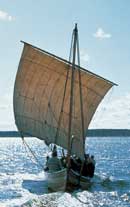
Wednesday, July 5: Roskilde: Cathedral, Viking Ship Museum
Thursday, July 6: Glyptoteket, National Museum, Freedom Museum.
Norway, Oslo: 3 nights
Friday, July 7: TRAIN RIDE TO OSLO: CITY TOUR.
Saturday, July 8: Oslo: Akershus Castle, Edvard Munch Museum.
Sunday, July 9: Norwegian Folk Museum, Viking Ship Museum.
Trondheim: 3 nights
Monday, July 10: TRAIN RIDE TO TRONDHEIM: CITY TOUR.
Tuesday, July 11: Nidaros Cathedral, Trondheim Art Gallery.
Wednesday, July 12: Trondelag Folk Museum, Museum of Art and Design.
sweden, Stockholm:
3 nights
Thursday, July 13: TRAIN RIDE TO STOCKHOLM. CITY TOUR.
Friday, July 14: Vasa Ship Museum, National Museum.
Saturday, July 15: Town Hall, Skansen Open Air Museum.
Denmark, Copenhagen: 1 night
Sunday, July 16: TRAIN RIDE TO COPENHAGEN: TIVOLI.
Monday, July 17:
6:25 a.m. Departure from Copenhagen to Seattle, Arrival 2:15 p.m.
(Northwest Airlines: Copenhagen-Amsterdam-Seattle)
 This
course rests on the premise that active, on-sight exposure to historical
artifacts of architecture, art, and contemporary cultural difference,
substantially expands a student’s cognitive horizon. The purpose
of this course is two-fold: (1) to achieve a basic, practical, cultural
competence of understanding of the two Scandinavian cultures: Denmark
and Norway; and (2) to express this understanding theoretically by examining
a selected topic in the traditional academic format of a research paper.
These dual purposes will be integrally connected through practical experience
and theoretical contemplation. E.g., the masterworks of artists studied
will be viewed in their originals; or, first-hand knowledge of the cultural
background of an author will procure a more profound understanding of
his literary art.
This
course rests on the premise that active, on-sight exposure to historical
artifacts of architecture, art, and contemporary cultural difference,
substantially expands a student’s cognitive horizon. The purpose
of this course is two-fold: (1) to achieve a basic, practical, cultural
competence of understanding of the two Scandinavian cultures: Denmark
and Norway; and (2) to express this understanding theoretically by examining
a selected topic in the traditional academic format of a research paper.
These dual purposes will be integrally connected through practical experience
and theoretical contemplation. E.g., the masterworks of artists studied
will be viewed in their originals; or, first-hand knowledge of the cultural
background of an author will procure a more profound understanding of
his literary art.
Our classroom will encompass the traditional classroom/discussion setting (during pre-departure meetings as well as class sessions during travel), intense and experiential hands-on learning in the two foreign cultures, and independent, scholarly activity under the guidance of the instructor. The learning outcomes of the course are as follows:
Students wil l
l
• do research on both general topics and a specialized topic and
produce a critical research paper
• interact communicatively in a foreign cultural environment
• confidently navigate foreign countries
• live and work cooperatively as a team
• productively transform knowledge into practical experience
• endure the physical and mental rigors of foreign travel These
learning outcomes have been identified in order to integrate fundamental,
academic, scholarly activity with the kind of personal confidence that
emanates from finding oneself competently handling unusual environments.
__________________________________
Contact us: honors@wsu.edu 509 335-4505 | Accessibility | Copyright | Policies
Honors College, PO Box 642012, Washington State University, Pullman, WA 99164-2012 USA