MFA THESIS,1994
CATALOG OF THE EXHIBITION
introduction by Deborah J. Haynes, Ph.D.
 return
THRESHOLD
A hand moves across the paper, the canvas, marking.
A hand strokes the metal, reshapes the wood.
A hand teases the clay toward impossibility.
Fingers tap keys.
This mind imposes a structure. As I contemplate the diversity of work reflected in the 1994 MFA Exhibition, an image comes: an art park, not an actual physical space, but a virtual reality. Put on these glasses, look into this imaginary space.
Miles Pepper's sculptures, like sentinels dancing in the wind, define both the historical and literal boundaries of the space. They speak of and with sculptural tradition; they rely on the specificity of materials. Ruth MacLaurin's totemic mixed media collages face simultaneously out and in, toward the real-life world of a small Nevada town and toward the world of Celtic myth and hidden mysteries. Look again, there is Rod Stuart's garden, a garden of language and sign. He tends it, invites us to enter and to see another world.
Around the edges I see surfaces, rich, painterly. Both Michelle Ross and Renee Taaffe-Johnson work at the intersection of, even the limits of, visual and verbal languages. Word meets image. Woman confronts nature. But who is actually represented and what is left for the viewer?
Into this space, Tracy Larson brings earth; Fernando Hernandez brings fire; Carl Richardson brings the music that animates the whole. Tracy's clay pieces remind us that all is transient in the real world of trees and broken leaves. The whimsical and surrealist spirit of Fernando's sculptures reminds us that even amidst the contingency and fragility there lives the imaginary, which liberates. And the music, the beat. Listen to the voice that sings through Carl's vivid and colorful canvases.
At the center, if spatial references have meaning in this imagined reality, Courtney Ingebritsen's computer. Demarcating a new set of aesthetic and technological boundaries, work such as hers has only just begun to challenge traditional definitions of art.
Someone once said that all art is autobiography. While this may not be true in the strictest sense, there is another way in which an artist's defining vision reflects and refracts her or his world. Not one world, but multiple worlds, multiple identities and subjectivities. This exhibition indeed reflects and refracts and crosses between the public and private worlds of the artists. Together they form a threshold into a new world, the one that will be in the future.
Deborah J. Haynes, Ph.D.
Assistant Professor of Art
Washington State University
EPILOGUE
Living in the southeastern corner of Washington state can be a stunning visual experience. Miles and miles of low rolling hills offer a year-round kaleidoscope of color and light that marks the growing cycles for peas, lentils, and wheat. Known as the Palouse, this region is a geological rarity (only northern China shares this terrain). These hills, once covered by native grasses waist high, are now a rich agricultural resource. They are believed to have been formed by windblown volcanic soil and the emptying of ancient glacial lakes. There is almost never a season of normal or average weather, which provokes a tolerance for the unusual here. Midsummer's hard winds animate the lush hills with a disorienting wave motion recalling the vast expanses of an ocean. To enter this place is to be confronted with strange vistas both spacious and contracting. The contradictory awareness of enclosure within the blunt hills and the sense of infinite distance create a complex and moving landscape.
Washington State University is situated on the edge of the Palouse in Pullman, Washington. Considered a cultural oasis in the midst of this remote area, the university continues to nurture artists who respond to the unique combination of academic community, fertile landscape, and the quiet seclusion of rural life.
Michelle Ross,
Graduate
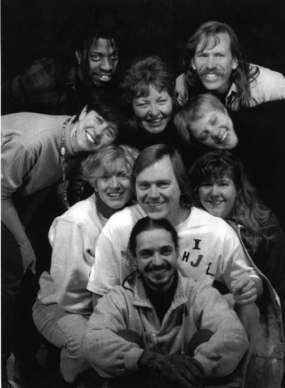
WSU's Department of Fine Arts faculty members have been privileged over the years to embrace graduate students from all parts of North America and as far away as South America, Asia, and Europe. The nine students represented in this catalog illustrate the diversity of artistic interests typical of our graduate students. We hope we have helped them to know themselves better and to create more meaningful art while living in our unusual community.
The fine arts faculty members join me in wishing our 1994 graduates a rich and exciting future.
Chris Watts,
Chair Department of Fine Arts Washington State University
ACKNOWLEDGMENTS
The second-year fine arts graduate students at Washington State University wish to extend our grateful- ness to those who have given generously to the creation of this exhibition and catalog. Special gratitude is expressed to Miles Pepper, who coordinated this catalog; to the College of Liberal Arts and the Department of Fine Arts for partial funding; to the Museum of Art for partial funding and exhibition support; to the Office of University Publications and Printing for partial funding and production of the catalog; to Professor Deborah Haynes for writing the introduction; to Michelle Ross for writing the epilogue; and to Courtney Ingebritsen for organizational support.
We are especially indebted to the faculty, spouses, and friends who have been supportive of us during the past two years.
return