
What is Environmental Justice Cultural Studies?
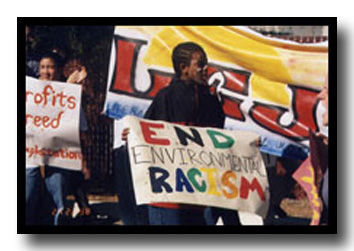
Environmental justice cultural studies is a branch of an emerging field that might be called "cultural environmental studies," or "environmental cultural studies." We give the name environmental justice cultural studies to work that analyzes and supports the movement that demonstrates how environmental problems cannot be solved apart from questions of economic and social justice, especially at the intersections of race, class, gender, sexuality, colonialism and "nature." More concretely, environmental justice cultural studies seeks to contribute to the less developed cultural side of EJ analysis, and to support cultural work (both works of analysis, and works of art and popular culture) that are vital to the movement for environmental and social justice.
The broader area environmental cultural studies (sometimes also called "green" cultural studies) is relatively unmapped terrain where cultural studies (broadly conceived) and environmental studies (broadly conceived) meet, overlap, and enter into dialogue.
The site and the field it hopes to help map form the cultural arm of the environmental justice movement. That movement has been dominated by crucial legal issues and debates about environmental science. In addition to adding crucial work on the role of cultural forms (literature, film, etc.) in the overall environmental justice project, ej cultural criticism can prove critical in understanding the social biases in the dominant legal and scientific discourses.
The field is interdisciplinary, drawing from environmental history, critical legal studies, social science, ethnic studies, women's studies, cultural geography, and other forms of cultural criticism. While much emphasis is placed on nature rhetorics and environmental discourses as representational systems, at its best the field weaves those interpretations into an understanding of material processes, political economy, and social institutions.
Most of the work we call cultural environmental studies so far centers around identifying and analyzing ways in which culturally constructed representations of Nature (in literature, in the arts, in popular culture, in scientific and social scientific rhetorics, in environmentalist discourses, in everyday common sense) shape our interactions with natural environments and shape our perceptions of environmental problems and solutions.
asks questions like:
- How do social and cultural issues surrounding race, class, gender, sexuality, region, eco-colonialism and their intersections shape environmental problems and their possible solutions?
- In what ways do literature, film, TV shows, pop songs and other cultural forms shape our everyday views of and interactions with our natural-cultural environments?
- At what social cost do we speak of "nature" or "the environment" as things outside the web of culture? How do we creatively demonstrate the interdependence of social and environmental sustainability?
- What limited cultural assumptions and outright cultural biases underlie scientific and social scientific understandings of the environment, furthering or impeding the linked pursuit of environmental and social survival?
- In what ways do cultural assumptions about race, class, gender and nationality shape the very terms of discussion and analysis used in environmental science and environmental studies?
- To what extent are the fields of "ecocriticism" and "green cultural studies" taking up the questions posed by the environmental justice movement? How might those fields be pushed to engage environmental justice more fully?
- the history of constructions of Nature or natures in landscape paintings and other works of visual art
- landscapes and built environments as cultural systems
- the rhetoric and imagery of nature in popular culture (TV nature documentaries, children's cartoons, pop music, etc.)
- poetry, fiction, and literary non-fiction that represent natural environments and/or offer environmental themes
- journalistic coverage of environmental and social justice issues
- gendered and racialized nature discourses wherever they ard found (as in terms like "mother nature" or "savage wilderness")
- cultural assumptions and social models embedded in the language of science and environmental science
- various environmentalist rhetorics (from Wise Use to Earth First!) that ignore or undermine questions of environmental justice
- communities as sites where local cultural history has shaped specific environmental justice understandings and interactions (i.e., pre- and post-Katrina New Orleans)
Objects of analysis for environmental justice critical and other cultural environmental studies practitioners include but are not limited to:
This site hopes to further discussion of how at every level, from the most abstract scientific data to everyday conversation, cultural assumptions shape perceptions and practices that can help or hinder our attempts to improve environmental quality. Whether you believe science, social science, or humanistic knowledge to be the most crucial factor in preventing further environmental degradation, no solution will be implemented without making convincing arguments sensitive to cultural contexts. Exploring and developing those cultural contexts in ways beneficial to healthier and richer human/natural environments is the goal of this site and of cultural environmental studies as an emerging field.