
Annotated Bibliography
Below is a brief list of texts that offer a variety of models of environmental justice cultural work, and broader works of environmental cultural studies that can prove useful in doing ej cultural analysis. In making our selections we have sought to move beyond the mostly literary dimensions of ecocriticism (the most well-established branch of cultural environmental studies), instead focusing mostly on work about other types and genres of cultural expression. The list highlights works of environmental justice criticism, literary and otherwise, that treat intersections of race, class, gender, sexuality, colonialism and "nature." We have included a few links to publishers and booksellers that offer a table of contents and other useful information on selected books; no endorsement of any bookseller is intended.
At the bottom of the page there are additional links to other bibliographies on environmental justice, environmental history, and mainstream ecocriticism.
FEATURED BOOKS:
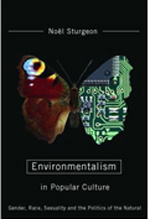 Noël Sturgeon, Environmentalism in Popular Culture: Gender, Race, Sexuality, and the Politics of the Natural. Tuscon: University of Arizona Press, 2009.
This is the first book to employ a global feminist environmental justice analysis to focus on how racial inequality, gendered patterns of work, and heteronormative ideas about the family relate to environmental questions. Beginning in the late 1980s and moving to the present day, Sturgeon unpacks a variety of cultural tropes, including ideas about Mother Nature, the purity of the natural, and the allegedly close relationships of indigenous people with the natural world. She investigates the persistence of the “myth of the frontier” and its extension to the frontier of space exploration. She ponders the popularity (and occasional controversy) of penguins (and penguin family values) and questions assumptions about human warfare as “natural.”
Sturgeon illustrates the myriad and insidious ways in which American popular culture depicts social inequities as “natural” and how our images of “nature” interfere with creating solutions to environmental problems that are just and fair for all. Why is it, she wonders, that environmentalist messages in popular culture so often “naturalize” themes of heroic male violence, suburban nuclear family structures, and U.S. dominance in the world? And what do these patterns of thought mean for how we envision environmental solutions, like “green” businesses, recycling programs, and the protection of threatened species?
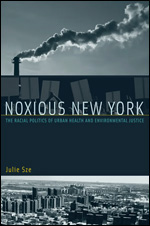 Julie Sze, Noxious New York: The Racial Politics of Urban Health and Environmental Justice. MIT, 2006,
Sze analyzes the culture, politics, and history of environmental justice activism in New York City within the larger context of privatization, deregulation, and globalization. She tracks urban planning and environmental health activism in four gritty New York neighborhoods: Brooklyn's Sunset Park and Williamsburg sections, West Harlem, and the South Bronx. In these communities, activism flourished in the 1980s and 1990s in response to economic decay and a concentration of noxious incinerators, solid waste transfer stations, and power plants. Sze describes the emergence of local campaigns organized around issues of asthma, garbage, and energy systems, and how, in each neighborhood, activists framed their arguments in the vocabulary of environmental justice.
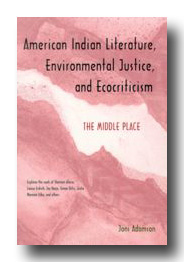 Joni Adamson,
American Indian Literature, Environmental
Justice and Ecocriticism: The Middle Place. Tucson: University of Arizona Press, 2001.
Joni Adamson,
American Indian Literature, Environmental
Justice and Ecocriticism: The Middle Place. Tucson: University of Arizona Press, 2001.
 Margo Tamez, Raven Eye. Tucson: University of Arizona Press, 2007.
RECOMMENDED READINGS:
- Alaimo, Stacy. "'Skin Dreaming': The Bodily Transgressions of Fielding Burke, Octavia Butler, and Linda Hogan." Eocfeminist Literary Criticism. Eds. Greta Gaard and Patrick Murphy. Urbana: University of Illinois Press, 1998.
- Explores the naturalization and denaturalization of racialized bodies in three very different writers.
- Asante-Darko, Kwaku. "The Flora and Fauna of Negritude Poetry: An Ecocritical Perspective." Mots pluriels. Sept. 1999.
- Examines neglected environmental concerns raised in the poetry of Caribbean "negritude" writers C?saire, Senghor, Birago Diop, Guy Tirolien, and Dadi.
- Bennett, Jane, and William Chaloupka, eds. In the Nature of Things: Language, Politics and the Environment. Minneapolis: University of Minnesota Press, 1993.
- Examines the social construction of "nature" and "the environment" using an intriguing mix of discourse analysis and political theory.
- Bennett, Michael, and David W. Teague, eds. The Nature of Cities : Ecocriticism and Urban Environments. Tucson: University of Arizona Press, 1999.
- Important collection that helps undermine the notion that nature somehow stops at the edge of cities, and explores a rich variety of ways to think about urban environments in an ecocritical context.
- Buell, Lawrence. The Environmental Imagination: Thoreau, Nature Writing and the Formation of American Culture. Cambridge, MA: Belknap Press of Harvard University Press, 1995.
- While constrained by excessive focus on the white male canon of nature writing, this extensive work is resonant with ideas on various genres of writing about the environment in the US context.
- Buell, Lawrence. Writing for an Endangered World. Cambidge, MA: Harvard University Press, 2001.
- Another encyclopedic work from Buell, this time making a passing nod to issues of environmental justice via a chapter on "Toxic Discourse," and treatment of a couple of writers of color. Contents and further info from amazon.com
- Braun, Bruce, and Noel Castree, eds. Remaking Reality: Nature at the Millennium. New York: Routledge, 1998.
- Rich collection of essays applying a variety of theoretical approaches to "social nature," and engaging with debates in politics, science, technology and social movements surrounding race, gender and class, the contributors explore important and emerging sites where nature is now being remade with considerable social and ecological consequences. See especially the essays by Katz, Watts, Latour, and Smith's afterword. Contents and further info from Routledge.
- Cantrill, James G., and Christine Oravec, eds. The Symbolic Earth: Discourse and our Creation of the Environment. Lexington, KY: University Press of Kentucky, 1996.
- The authors demonstrate a range of ways in which the preservation of the earth is dependent upon changing discursive practices, as well as and as intertwined with, material practices.
- Carr, Glynis, ed. "New Essays in Ecofeminist Literary Criticism." Bucknell Review 44.1 (2000). Also published in book form by Bucknell Press.
- See especially the essays by Sze on Karen Yamashita, Blend on Chicana writers, and Gaard on Linda Hogan and Alice Walker. Demonstrates the strong tendency in much recent ecofeminist criticism to align itself with environmental justice concerns.
- Comer, Krista. Landscapes of the New West: Gender and Geography in Contemporary Women's Writing. Chapel Hill: University of North Carolina Press, 1999.
- Works to lessen the grip of the "wilderness plot" and other elements of frontier mythology surrounding writers from the Western US, raising new questions about gender, race, and environment. Demonstrates how even otherwise progressive writers like Silko and Kingsolver have been trapped at times in these imperialist and racist tropes.
- Cronon, William. Changes in the Land: Indians, Colonists and the Ecology of New England. New York: Hill and Wang, 1983.
- Important study of European-native conflicts rooted in cultural differences in conceptualizations of what whites called "nature."
- Cronon, William. "The Trouble with Wilderness: Or Getting Back
to the Wrong Kind of Nature." Uncommon Ground. Ed. William Cronon. New York: W.W. Norton and Co., 1995. 69-90.
- Succinct and brilliant critique of the ecological and political dangers inherent in the concept of "wilderness." See also the responses to this essay by Hayes, Dunlap, and Cohen, in Environmental History 1.1 (1996): 29-46.
- Cronon, William, ed. Uncommon Ground: Toward Reinventing Nature. New York: W.W. Norton and Co., 1995.
- An impressive and wide-ranging anthology that includes work from Richard White, Donna Haraway, Anne Whiston Spirn and Susan Davis, among others, treating environmental rhetorics in popular culture, science, the arts, and movements. Contents and further info from EcoBooks.
- Deming, Alison, and Laurel E. Savoy, eds. The Colors of Nature: Culture, Identity, and the Natural World. Berkeley: Milkweed, 2002.
- A rich anthology of writing from African Americans, Latino/as, Asian Americans, Native Americans, mixed race writers and others that brilliantly challenges the assumption that nature writing is white writing. The editors demonstrate that the alleged "'lack' of nature writing by people of color reflects the limited perspective of both the defining audience and the publishing community more than lack of interest in the natural world by writers of color."
-
Di Chiro, Giovanna. "Nature as Community: The Convergence
of Environment and Social Justice."
Privatizing Nature: Political Struggles for the Global Commons.
Ed. Michael Goldman. New York: Pluto Press, 1998. 120-143. Also reprinted in Cronon, ed.
Uncommon Ground.
- Rich set of arguments about the natural disaster of intellectually separating the environment from questions of society and culture.
- ---. "Environmental Justice from the Grassroots: Reflections
on History, Gender, and Expertise." The
Struggle for Ecological Democracy: Environmental Justice Movements
in the United States. Ed. Daniel Faber. New York: Guilford, 1998. 104-136.
- Excellent summary of key factors in the rise of the environmental justice movement, with a special focus on the constricted definitions of environmental "expertise" and the role of women in the movement.
-
Faber, Daniel, ed. The Struggle for Ecological Democracy.
New York: Guilford Press, 1998.
- Excellent, important collection of essays rooting environmental cultural studies in political economy and the search for substantive democracy.
-
Gaard, Greta, and Patrick D. Murphy, eds. Ecofeminist
Literary Criticism: Theory, Interpretation, Pedagogy.
Urbana: University of Illinois Press, 1998.
- Wide-ranging collection that at its best brings questions of race, class, gender, colonialism and nature to bear on key literary texts and literary critical questions.
-
Gedicks, Al. The New Resource Wars: Native and Environmental
Struggles Against Multinational Corporations. Boston: South End Press,
1993.
- Key collection rooting environmental struggles in indigenous peoples' struggles for sovereignty and cultural survival.
-
Gottlieb, Robert. Forcing the Spring: The Transformation
of the American Environmental Movement. Washington, DC: Earth Island Press,
1993.
- First book to fully weave worker safety issues and environmental justice concerns into a general history of US environmentalism. A major work of revisionism.
- Gottlieb, Roger S., ed. The Ecological Community:
Environmental Challenges in Philosophy, Politics, and Morality.
New York: Routledge, 1997.
- Philosophical, political and ethical issues going beyond the limits of a narrow environmental ethics.
- Guha, Ramachanda. "Radical American Environmentalism and Wilderness
Preservation: A Third World Critique." Environmental
Ethics 11.1 (1989): 71-84.
- Classic statement of the dangers of wilderness purism when looked at from the perspective of Third World economic, political, and ecological realities.
- Haraway, Donna. Primate Visions. New York: Routledge, 1989.
- Brilliant reinterpretations of the history of primatology, natural history museums, and other constructions of human and non-human "natures."
- Haraway, Donna. Simians, Cyborgs and Women: The Reinvention
of Nature. New York: Routledge, 1991.
- Superb collection of essays on the ways in which, for better and for worse, recent historical developments have blurred the border between nature and culture, animal and human, biology and society.
- Harvey, David. Justice, Nature and the Geography of
Difference. Cambridge, MA: Basil Blackwell, 1999.
- Harvey offers a reframing of historical-geographical materialism in light of issues of environmental justice and postmodern socio-cultural conditions on a global scale.
-
Herndl, Carl G., and Stuart C. Brown, eds. Green Culture:
Environmental Rhetoric in Contemporary America. Madison: University
Wisconsin Press, 1996.
- Examines a variety of environmental rhetorics from nature writing to Earth First! to toxic waste techno-speak.
- Hofrichter, Richard, ed. Reclaiming the Environmental
Debate: The Politics of Health in a Toxic Culture. Cambridge, MA: MIT
Press, 2000.
- Excellent, wide-ranging collection that artfully combines political and cultural analysis of various environmental health issues. Includes strong essays that deconstruct the concepts of "toxicity" and "risk," "green capitalism," and "toxic tourism," as well as discussions of environmental justice art and media, and a host of other topics.
- Ivakhiv, Adrian.
"Ecocultural Critical Theory and Ecocultural Studies."
- Wide-ranging attempt to define/survey the field of environmental cultural studies.
- Ivakhiv, Adrian.
"Environmental
Cultural studies: Debating the 'social construction of nature'"
- Surveys main debates among those trying to bridge environmental and cultural studies.
- Ivakhiv, Adrian. "Whose
Nature? Reflections on the Transcendental Signified of an Emerging
Field." The Virtual Pomegranate.
8 (1999).
- Traces some of the key intellectual issues surrounding attempts to define and own the concept and reality of "nature."
- Karliner, Josh. Corporate Planet: Ecology and Politics
in the Age of Globalization. San Francisco: Sierra Club, 1997.
- Excellent, accessible analysis of corporate pseudo-environmentalism, and the role of the World Bank, WTO (World Trade Organization) and other agents of globalizing capitalism in wreaking environmental damage and undercutting worker-environmentalist alliances.
-
Kirk, Gwyn. "Ecofeminism and Environmental Justice: Bridges Across
Gender, Race, and Class." Frontiers 18.2 (1997):
2-20.
- Savvy analysis by an experienced activist about the pitfalls and possibilities of alliances between two of the most dynamic elements of current environmental movements.
-
Knobloch, Frieda. The Culture of Wilderness: Agriculture
as Colonization in the American West. Chapel Hill: University of North
Carolina Press, 1996.
- Excellent study of agricultural colonialism in the US west as it shaped and destroyed cultures.
- Kollin, Susan. Nature's State: Imagining Alaska as the Last Frontier. Chapel Hill: University of North Carolina Press, 2001.
- Uses postcolonial and environmental justice theory to explore the gendered and racialized nature of eco-imperialism and social anxieties about nature, ethnicity and national identity in the context of the Northern "frontier" of the US. Re-thinks a range of writers from John Muir and Jack London to Margaret Murie, John McPhee and Barry Lopez.
- Kuletz, Valerie. Tainted Desert. New York: Routledge, 1998.
- Excellent study of the environmental impact of nuclear testing and uranium mining on the cultures, peoples, and landscape of the US Southwest.
-
Luke, Timothy. Capitalism, Democracy, and Ecology.
Urbana: University of Illinois Press, 1999.
- Wide-ranging, lucid critique arguing that a new alliance of the oppressed centered on environmental concerns is the best chance for global democracy, social justice and ecological sustainability.
-
Luke, Timothy. Ecocritique: Contesting the Politics
of Nature, Economy, and Culture. Minneapolis: University of Minnesota,
1997.
- Insightful set of readings of various environmentalist discourses, from Nature Conservancy to Earth First! that argues for a more complex understanding of the cultural and political economy of "nature" and the "natural," and reveals underlying patterns of assumption about power and agency. For Luke's own contextualizing of his book, click here.
-
Merchant, Carolyn. Death of Nature. San Francisco: Harper and Row, 1980.
- ___. Ecological Revolutions: Gender, Nature and Science in New England. Chapel Hill: University of North Carolina Press, 1989.
- Merchant's two classic studies bring questions of gender and race to bear on the conceptualization of "Nature" in American thought and social practice.
-
Milton, Kay. Environmentalism and Cultural Theory:
Exploring the Role of Anthropology in Environmental Discourse.
New York: Routledge, 1996.
- Useful systematic study of current and possible future uses of anthropological theory and cultural theory in general in analyzing relations between peoples and environments.
- Mitman, Greg. Reel Nature: America's Romance With
Wildlife on Film. Cambridge, MA: Harvard University Press, 1999.
- Important, wide-ranging study of nature documentaries in film and television.
- Nash, Roderick. Wilderness and the American Mind. New Haven: Yale University Press, 1967.
- Classic long-range study of how Americans have understood and used the concept of "wilderness."
-
Neuzil, Mark, and William Kovarik. Mass Media and
Environmental Conflict: America's Green Crusades. Thousand Oaks, CA: SAGE, 1996.
- Analyzes mainstream (and some alternative) framing of environmental issues by the media.
- Novak, Barbara.
Nature and Culture: American Landscape
Painting, 1825-1875. New York: Oxford University Press, 1980, 1998.
- The standard work on landscape painting in the US.
- Oelschlaeger, Max. The Idea of Wilderness from Prehistory
to the Age of Ecology. New Haven: Yale University Press, 1991.
- Long range view of this key concept in nature studies.
-
O'Meara, Bridget. "The Ecological Politics of Silko's Alamanac
of the Dead." Wicazo Sa Review 15.2 (2000): 63-73.
- Insightful study of the links between environmental and social justice in Silko's monumental novel.
-
Peet, Richard, and Michael Watts, eds. Liberation
Ecologies: Environment, Development, Social Movements. New York: Routledge,
1996.
- Collection of essays arguing various versions of a "discursive materialist" environmentalism that examines relationships between the "social construction of nature" and the "natural construction of society" mediated through various local-regional "environmental imaginaries." Especially strong in articulating complex Third and Fourth World critiques of and social movements against Western, capitalist environmentally and socially destructive forms of so-called "development."
- Pellow, David, and Lisa Sun-Hee Park. The Silicon Valley of
Dreams" Environmental Injustice, Immigrant Workers, and the High-Tech
Economy. New York: NYU Press, 2002.
- Important study extending analysis of the impact of environmental racism and injustice to immigrant workers of color in the high tech industries of places like Silicon Valley. Also assesses the implications of this wider definition of environmental racism with regard to relations between immigrants of color and long-time US citizens of color.
-
Peña, Devon, ed. Chicano Culture, Ecology,
Politics: Subversive Kin. Tucson: University of Arizona Press, 1998.
- Outstanding collection of essays detailing interrelations between Chicano cultural/political struggles, and environmental struggles around pesticides, pollution, toxics, land stewardship and other concerns.
-
___. Terror of the Machine: Technology,
Work, Gender and Ecology of the U.S.-Mexico Border. Austin: CMAS Books, 1997.
- Superb exploration of the social and environmental costs of the maquiladoras, embedded in an auto-ethnography of the culture(s) of Mexican and Chicana women workers.
-
Platt, Kamala. "Chicana Strategies of Success and Survival:
Cultural Poetics of Environmental Justice from the Mothers of
East Los Angeles." Frontiers 18.2 (1997): 48-72.
- Develops the concept of "cultural poetics" to analyze the race, gender and class dynamics of a key Chicana environmental justice organization.
-
___. "Ecocritical Chicana Literature: Ana Castillo's
'Virtual Realism.'" Isle 3.1 (Summer 1996): 67-96.
- Explores the centrality of environmental justice themes in Castillo's So Far From God.
-
Pulido, Laura. Environmentalism and Economic Justice.
Tucson: University of Arizona Press, 1996.
- Rich reading of Chicano and hispano environmental/economic justice movements in terms of positionality, material processes and culture.
- Robertson, George, et al., eds. Futurenatural: Nature, Science, Culture. London: Routledge,
1996.
- Intriguing collection of essays on nature and postmodernity. See especially the pieces by Smith and Ross.
-
Ross, Andrew. Strange Weather: Culture, Science and
Technology in the Age of Limits. London: Verso, 1991.
- Collection of essays analyzing New Age science and other dimensions of popular environmentalism.
- Slack, Jennifer, and Laurie Anne Whit."Ethics and Cultural Studies." Cultural Studies. Eds. Lawrence Grossberg, et al. New York: Routledge, 1992: 571-91.
- Influential essay calling for "ecocultural" ethics as a ground for cultural studies work.
- Smith, Neil. Uneven Development: Nature, Capital and the Production of Space. Oxford: Blackwell, 1984.
- The locus classicus for the important Marxist concept of the "production of nature," an argument that capitalism has all but wholly subsumed and commodified the natural environment.
- Sophia, Zoe. "Exterminating Fetuses: Abortion, Disarmament, and the Sexo-Semiotics of Extraterrestrialism." Diacritics: A Review of Contemporary Criticism 14: 2 (Summer 1984). 47-59.
- Brilliant analysis of "techno-fetishism" and waste phobia in popular film discourse.
- Stein, Rachel. Shifting the Ground: American Women Writers' Revision of Nature, Gender and Race. Charlottesville, VA: University Press of Virginia, 1997.
- Excellent study focusing on ways in which Emily Dickinson, Zora Neale Hurston, Alice Walker, and Leslie Silko, negotiated the intersections of race, gender, and notions of nature.
- Stein, Rachel. "'To Make the Visible World Your Conscience': Adrienne Rich as Revolutionary Nature Writer." Reading Under the Sign of Nature: New Essays in Ecocriticism. Ed. John Tallmadge and Henry Harrington. Salt Lake City: University of Utah Press, 2000. 198-207.
- Rereads Rich as a poet concerned with the intersections of gender, race and the natural environment.
- Sturgeon, Noël. Ecofeminist Natures: Race, Gender, Feminist Theory and Political Action. New York: Routledge, 1997.
- Brilliant interpretation of the problem essentialism in US environmentalisms that offers an alternative racial and gender politics, and a concept of "direct theorizing" of use for cultural environmental analysis and social movement action.
- Sturgeon, Noël, guest ed. "Intersections of Feminisms and Environmentalisms." special issue of Frontiers 18.2 (1997).
- In addition to essays by Comer, Kirk, Kollin, and Platt, cited elsewhere in this bibliography, see the pieces by Sandilands, Carden, and Di Chiro, and the interesting works of visual art in this volume.
- Szasz, Andrew. Ecopopulism: Toxic Waste and the Movement for Environmental Justice. Minneapolis: University of Minnesota Press, 1994.
- Crucial study of the politics and culture of the EJ movement.
- Walton, John. Western Times and Water Wars. Berkeley: University of California Press, 1993.
- Explores the strategies of Owen Valley residents who, over seventy years, resisted the bid by the city of Los Angeles to export their water resources.
- White, Richard. "Are You an Environmentalist or Do You Work for a Living?: Work and Nature." Uncommon Ground. Ed. William Cronon. New York: W.W. Norton and Co., 1995. 171-85.
- Perceptive and witty analysis of the ways in which certain environmentalist rhetorics exclude the knowledges and rights of those who work the land, and a sharp critique of the deadend environmentalist strategy that seemingly pits work against wilderness.
- White, Evelyn C. "Black Women and the Wilderness." In Teresa Jordan and James Hepworth, eds. Stories that Shape Us: Contemporary Women Write about the West. New York: Norton, 1995.
- Tells the story of a black woman haunted by bone-deep memories of slave catchers, the KKK and the death of Emmett Till, who finds a way past her fear of wildnerness to take her rightful place there.
- White, Richard. The Organic Machine. New York: Hill and Wang, 1995.
- Examines the entanglement of built and natural environments by studying the Columbia River system with its dams, its vat-grown salmon, and the computerized monitoring system (CRiSP) used to predict environmental outcomes.
- Worster, Donald. Nature's Economy: A History of Ecological Ideas. Cambridge: Cambridge University Press, 1985, 1977.
- Lucid and comprehensive historical analysis of ecology and ecological concepts.
- ___. Under Western Skies: Nature and History in the American West. New York: Oxford University Press, 1992.
- A re-telling of the history of the US West as a struggle between native peoples and newcomers, fought partly through struggles around conflicting meanings and uses of the land.
-
Environmental
Justice Bibliography.
Environmental Inequality Bibliography. - Two excellent resources from Andrew Szasz and Michael Meuser.
- Environmental Justice: A Bibliography with Abstracts (PDF).
- Useful list but skewed toward government and scientific publications on EJ; prepared by the National Institutes of Health.
- American Environmental History.
- Includes a number of bibliographies, some according to region.
- Ecocriticism Bibliographies.
- A collection of bibliographies on environmental literary criticism and related topics from ASLE