CATALOG OF THE EXHIBITION
introduction by Deborah J. Haynes, Ph.D.
index
As we speed toward the millennium, it comes as no surprise that artists are gripped by a keen awareness of time. Time: in the simplest terms, the past, the present, the future. Time: memory
of the past, awareness of the present, anticipation of the future. Time: that nebulous galaxy-like swirl in which we have our fleeting existence. But do we really have existence? We exist in
a framework of time, what Russian philosopher Mikhail Bakhtin called "great time," a trajectory that is shaped by our cultural histories. We also exist in a system and galaxy, that seems so
significant to each of us. Why? Because we love; we experience loss, we grieve; we know joy and must celebrate; we think. The work in this exhibition - by Kyung-ae Kong, Elizabeth
Nannini, Valerie Romain, and Alisa Savage - may be viewed as a series of meditations on time.
Kyung-ae Kong's paintings and prints express an exuberance and joy that belie the profound stresses and divisions in her native Korea. Her work, with its expressive brushstrokes and
brilliant pure color, speaks of the joie de vivre that characterized many of Henri Matisse's early Fauve paintings. Densely layered strokes, patterns, splashes, and splatters of color create a
comfortable feeling in the viewer. We do not know what particular message the artist wishes to convey, only that the energy and vitality of life in the present are ongoing, unstoppable. Life,
lived here, now, is a dynamic tension of action and non-action, of doing and not-doing. Art such as Kong's that expresses this tension cannot fail to attract us.
Elizabeth Nannini's constructions take us back to another time, a time of medieval relics and rituals. Every form, every element, contains its own symbolic meaning. But in this work we
confront a profound dilemma. We do not know to what past the relics refer, and we do not know what rituals they might be part of. We stand before the work as if we are pilgrims from a
foreign land, on a pilgrimage that leads... we know not where. Wood and wire, metal and paper, found objects and boxes: these materials link her work to that of Joseph Cornell and George
Herms. Nannini's gift, like theirs, is to make us look, and look again. To stand with her before the unknown and the mysteries of life, and death. This is the postmodern condition for many of
us.
Valerie Romain's wall paintings and her hanging figures similarly take the past as their point of reference. But here we are invited to witness a personal past in Trinidad. Memory is
stimulated by photographs; personal experience is the primary source. The large paintings themselves picture the power of the elements - the wind, the sea, the sky, fire. Are these
disasters? The paintings ask, at what level have we all experienced the tragic'? They do not seek verisimilitude to nature, but their truth is interior. The figures inhabiting the space between
the wall paintings are ghostly presences of the real. Like May Steven's exquisite painted portraits, Romain's figures are shadows that remind us of the contingent nature of existence.
Alisa Savage's clay sculptures lead us toward the unknown future. In her work, the personal is absent,except in the sense that we see traces of the artist's hand in shaping the clay. Curled lips, clipped wings, extended fins: these modelled forms extend from otherwise smooth surfaces,
creating a haunting visual contradiction. What are these creatures, or can they be called "creatures" at all? Are they new cyborgian combinations of natural and technological elements like
we see in Lynn Randolph's paintings? Are they kin to Salvador Dali's strange surrealist forms? Are they breathing, or are these simply skeletons of a life once lived? Savage tests us. She
wants us to think about ends, and about beginnings.
Time is a construct that cannot be grasped without the aid of the imagination. Artists such as these, trained to watch the ever-flowing stream of imaginary thoughts and visions, can help us to
understand the meanings of the past, of the present, and of what is yet to come.
- Deborah J. Haynes, Ph.D. Assistant Professor of Fine Arts
"I was driven to Pullman from Canada in my friend's car. I fell asleep at Snoqualmie and when I woke up, we were on the Palouse. For a few seconds, I truly thought we had landed on another planet. I saw tumbleweeds and the sky went on forever. Being here gave me time and space to think about my art, my future, and being true to my ideals." - Valerie Romain
"I grew up in small towns like this, where I can walk down the street without getting hit over the head. I felt comfortable when I came here, but not with my work. I wanted to try some- thing new. Here I was encouraged to experiment and now I'm incorporating my interest in sci-fi into my forms. I'm more satisfied with my sculpture because I'm doing what I want to do instead of what's expected of me. Now that I'm leaving, I'm uncomfortable about what the future may bring - like moving to a big city - but not about my sculpture." - Alisa Savage
"Being surrounded by Pullman's wheat fields and blue skies changed my life. This kind of landscape, where a bird is the only motion, inspired me to work. It makes me feel solemn. Those are the birds I paint. The Palouse's weathered barns, fences, and open areas of land bring me a sense of much-needed spiritual isolation." - Kyung-Ae Kong
"Living on the Palouse has enhanced my preoccupation with food and art. I've gained ten pounds since I've been here, but I would never have been able to make this stuff at home." - Elizabeth Nannini
WSU's Department of Fine Arts faculty members have been privileged over the years to embrace graduate students from all parts of North America and as far away as South America, Asia, and Europe. The four students represented in this catalog illustrate the diversity of artistic interests typical of our graduate students. We hope we have helped them to know themselves better and to create more meaningful art while living in our unique rural community.
The fine arts faculty members join me in wishing our 1996 graduates a rich and exciting future. - Chris Watts, Chair
We, the second-year graduate art students, wish to express our gratitude to all those who have given generously in order for our MFA exhibition and catalog to be created. The College of Liberal Arts, the Graduate College, the Vice Provost for Academic Affairs, the Office of University Publications and Printing, the Graduate and Professional Student Association, and the Department of Fine Arts contributed funds for this catalog's production. The exhibition was coordinated and supported by the Museum of Art staff and the Friends of the Museum.
We are indebted to the fine arts faculty and staff of Washington State University for their understand- ing, guidance, and instruction. We will forever strive to follow their example as
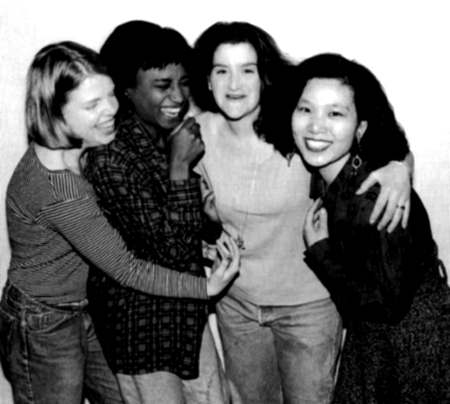
teachers and artists. Special appreciation is extended to Brendan Regan for his courage in taking the group photo. Finally, we thank spouses, friends, families far away, fellow art students,
Yuri, Trotsky, Evil, rats, and hedge- hogs for their patience, love, and support during the past two years.
return