CATALOG OF THE EXHIBITION
introduction by Carol S. Ivory, Ph.D.
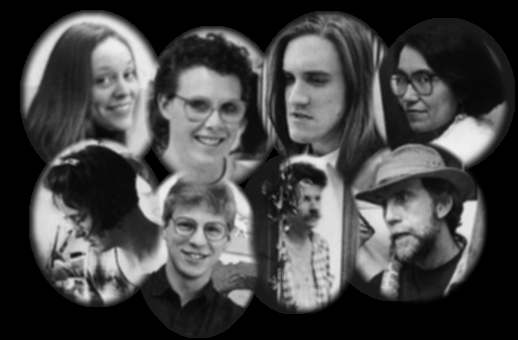
- Kimberley A. Bursic
- Diane R. Curtis
- Marcia C. Harvey
- Marshall L. Hoyt
- Shawn Kielty
- Margarita Perez
- George Chatillon Reiley
- Gerald R. Steffen
Perhaps more than ever before in history, we need artists. We see much ugliness, much confusion, much despair in the world - it comes into our homes on CNN every night. The arts right now are under attack by those who are too narrow-minded to understand that art has been with us as long as we have been human, and will remain with us as long as we humans exist. Within weeks of my writing this, a new cave was discovered in France, 20,000 years old, with more than 300 paintings as new and vibrant as the day they were made. This cave is not unlike others in Australia, half a world away and perhaps twice as old. Art endures, and despite the differences in time and space, the task of the artist is the same: to understand and interpret the meaningful in life, to mediate between past and present, between body and spirit, between earth and beyond, between hope and despair.
The artists we celebrate in these pages address these very issues today in their work, too. They are Kimberley A. Bursic, Diane R. Curtis, Marcia C. Harvey, Marshall L. Hoyt, Shawn Kielty, Margarita Perez, George Chatillon Reiley, and Gerald R. Steffen. These eight women and men have been here for two years on a journey of growth, discovery, and self-fulfillment. It was a journey that transported them to the rolling hills of the Palouse, sequestered them in the nooks and crannies of the Fine Arts Center, freed them to seek and confront their inner selves, and challenged them to share their discoveries about life, this earth, this moment, with us, their audience, their teachers, their friends.
Their work may confuse us, inspire us, thrill us, upset us, provoke us, or reassure us. In different ways, each of the eight artists speaks to the issues central to our lives as we near the end of another millenium. We come closer to nature, to the spiritual, to the perils facing the environment in many of the artists' work. Marshall Hoyt forces us to look at the wastefulness of our culture and the need to reverence and reuse what we can. George Reiley's sculptures evoke a tactile topography, a landscape of their own that takes us on the journey with him in, through, and around their surfaces, questioning our understanding of our own landscapes.
Shawn Kielty explores in his constructions notions of home, of the secret, of self-identity, of the power in found objects, and the transformations in us and them as he wraps, encloses, attaches, and makes them his own. Many of these same concerns emerge in Marcia Harvey's multi-layered works where she partially conceals messages, intriguing us with hidden meanings found in repeated motifs played out in ever-changing ways. They repeat in Kimberley Bursic's pieces where the resonance of memory serves as a metaphor for art, ever-changing, adding layers of meaning like paint, and in the process creating something new.
Margarita Perez uses words, religious icons, and images of her own body to explore the inner world of the spirit, of self-identity, of being. Diane Curtis searches for glimpses of life, for the unexpected connections between moments, hoping to find in these small snatches a way to view a world too awesome to compre- hend in its entirety. Finally, Gerald Steffen challenges our notions of just what art is, of its relationship to our pop culture, to his and our own life experiences.
We need each of these artists. They enrich our lives and expand our understanding of ourselves and our world in their own special and particular ways. We congratulate them on their growth and achievements in these past two years, and we wish them courage and strength as they leave us to continue on their own personal journeys.
Carol S. Ivory, Ph.D.
Assistant Professor of Fine Art
Washington State University
Tacking, cutting, nailing, brushing, gluing, layering, sewing, scraping, shaping, selves. August 1993-May 1995. Between these two portals lay opportunities for transformation of both raw materials and of the self, of being.
The pieces in this exhibition document the personal transformations we have undergone. Not only has graduate school provided an opportunity for us to hone our technical skills, it has allowed us time to give shape and expressions to those ideas that engage our minds and stir our souls.
This exhibition is more than a celebration of our two years here. It is an expression of a personal and artistic evolution that transcends the brushstroke, the mark, the twisted piece of metal. Evidence, residue; these things tell of our experiences at a deeper level, in a richer, more intense space and of our desire to look honestly into this space again and again.
-- Diane R. Curtis and Marcia C. Harvey, 1995 graduates
WSU's Department of Fine Arts faculty members have been privileged over the years to embrace graduate students from all parts of North America and as far away as South America, Asia, and Europe. The eight students represented in this catalog illustrate the diversity of artistic interests typical of our graduate students. We hope we have helped them to know themselves better and to create more meaningful art while living in our unique rural community.
The fine arts faculty members join me in wishing our 1995 graduates a rich and exciting future.
-- Chris Watts, Chair
Department of Fine Arts
Washington State University
On behalf of the graduating MFA students, it is my pleasure to acknowledge those who have made this exhibition and catalog possible. I would first like to thank people whose direct financial contributions have made possible the publication of this catalog: John Pierce, Dean, College of Liberal Arts; Robert Smith, Dean, Graduate School; Geoffrey Gamble, Vice Provost of Academic Affairs; the Museum of Art; and Chris Watts, Chair, Department of Fine Arts. I would also like to thank the Office of University Publications and Printing for producing this catalog and the Museum of Art for providing exhibition space. We are indebted to Kim Bursic, whose organizational efforts have not only contributed to the creation of this catalog but also to an alternative MFA exhibit at the WSU Livestock Pavilion. I cannot end without recognizing the faculty and staff of the Department of Fine Arts for their help and support and Carol Ivory for writing the catalog's introduction. An extra special thanks is extended to Chris Watts, who always seemed to have the right answers before we even knew what the questions were. To all of our family members and friends who have supported and tolerated us during the past two years, our undying gratitude is yours. We couldn't have done it without you.
-- Gerald Steffen, Graduate Student
return