Notes for Salman Rushdie: The Satanic Verses
Chapter I: The Angel Gibreel
Plot Summary for Chapter I
This chapter is preceded by an epigraph from Book I, Chapter VI of Daniel Defoe's The Political History of the Devil as well Ancient as Modern (London: T. Warner, 1726), p. 81. Defoe's location of Satan's abode as the air is of course highly appropriate for this novel in which the demonic falls from the air. But more importantly, the Devil is a wanderer, an image of the rootless immigrant. More details from Martine Dutheil.
The novel opens with the two main characters, Gibreel Farishta and Saladin Chamcha, falling to earth because the plane they have been flying in has just been blown up by the terrorists who have hijacked it. We are then told a good deal of detail about their backgrounds, their occupations, their love affairs, and how they happened to find themselves together on the plane. Then the story of the hijacking is told, leading up to the moment of explosion which began the novel.
Page 3
Notes for Chapter I
Why do you think the novel begins the way it does?
Ta-taa! Takathun!
Syllables used in teaching traditional rhythms.
Baba
A common meaning is "old holy man," but Rushdie points out that in this context it "means 'young fellow,' or even in certain contexts "mister" or "sir." (Hindi, Urdu) (personal communication from Salman Rushdie).
If you want to get born again . . .
. . . first you have to die. See note below, p. 85 [86], note on Gramsci.
twenty-nine thousand and two feet
The height of Mount Everest, to which the height of the fall is compared on the next page. Falling is a major motif throughout the novel (Seminck 35). See, for instance, note below on p. 133 [137]. Everest from Kala Patar.
'I tell you, you must die, I tell you, I tell you,'
Refrain from "The Whisky Song" from Bertolt Brecht and Kurt Weill's The Decline and Fall of the City of Mahagonny (1930) memorably recorded by Jim Morrison as "Alabama Song (Whisky Bar)" on the album The Doors.
gazal
A classical Persian poetic form. More commonly ghazal (also Urdu).
bhai
Brother (Hindi).
yaar
Friend (Hindi).
Dharraaammm
Sound of the impact of something that has fallen (Hindi).
Page 4
big bang
Refers to the explosion which astrophysicists posit began the universe.
Bostan
One of the traditional heavens of Islam, another being Gulistan (Farsi). Two famous 13th-century Persian didactic classics by Sadi are titled Bostan and Gulistan (Mojtabai 3). See pp. 31, 364 [376] & 512 [526].
Flight AI-420, blew apart without any warning
This incident seems to be a conflation of elements based on two different events. On June 14, 1985 a TWA flight was hijacked by a band of Shiite terrorists, from Athens to a series of airports, ending in Beiruit, where the plane sat on the runway until July 1, with people being released at various intervals. On June 23, 1985, Air India (AI) Flight 182, en route from Canada via London to India, crashed into the ocean 120 miles southwest of Ireland, killing all on board. Sikh separatists were suspected of having planted a bomb (see Jiwa).
After the publication of the novel, on December 21, 1988 Pan Am Flight 103 was blown up by a terrorist bomb over Lockerbie, Scotland, killing all on board in a manner strikingly reminiscent of the Flight A I-420 explosion. The flight number has negative associations discussed in the second note on p. 5, below. Some Indian readers saw a parallel of this scene to a scene in An Evening in Paris (Paris Ki Ek Shyam, 1967, dir. Shakti Samanta), a Bombay film in which Shammi Kapoor descended from a helicopter singing to a water-skiing Sharmila Tagore, "Asman se aya farishta" ("An angel has descended from the sky") (Ali 295). A chronology of hijackings. Information about Shammi Kapoor. He is the son of Raj Kapoor.
Mahagonny
See above, note for p. 3
Babylon
The capital of the Neobabylonian ( Chaldean) Empire which conquered ancient Judea and took the Jews into exile; in prophetic writings and in the book of Revelation a synonym for decadent apocalyptic evil; in first century Christian thought a metaphor for Rome, later used as a label for any great power seen as evil; in Jamaican Rastafarian thought, the capitalist world and more specifically, The United States.
Alphaville
The weirdly dehumanized futuristic city of Jean-Luc Godard's 1965 film by the same name. Poster for the film.
Vilayet
Literally "foreign country," used as a name for England (Hindi).
winked blinked nodded
Allusion to the childhood rhyme by Eugene Field, "Wynken, Blynken, and Nod." Text of the poem.
a quantity of wives . . . a sufficiency of children
Rushdie would seem to have forgotten that on p. 79 [80] it is said that the women and children were all previously released by the hijackers.
What aspects of the immigrant experience are alluded to in the bottom paragraph on this page?
Page 5
English Sleeve
The French name for the English Channel is La Manche, which means "the sleeve."
"Oh, my shoes are Japanese . . ."
The song is "Mera joota hai japaani" from the 1955 film Shree 420 (Mr. 420), directed by Raj Kapoor, music by Shankar Jaikishen, lyrics by Shailendra and Hasrat Jaipuri:
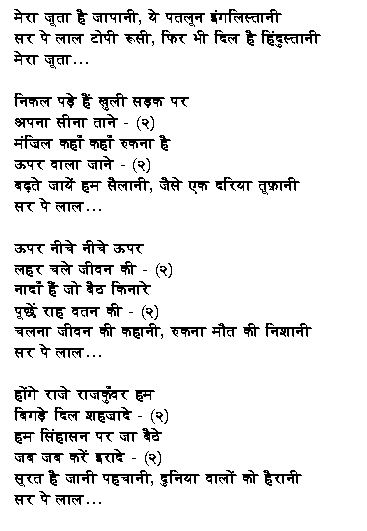 Translation of the song lyrics:
My shoes are Japanese,
These pants are English
The red hat on my head is Russian
Still my heart is Indian.
(walking)
I'm out on the open road, proud-chested
Only God knows where all I might go
I'll move onward like a raging flood.
My shoes are Japanese,
These pants are English
The red hat on my head is Russian
Still my heart is Indian.
(on camel)
Up and down, down and up moves the wave of life
Those who sit on the river bank and ask the way home are naive
Moving on is the story of life, stopping is the mark of death.
My shoes are Japanese,
These pants are English
The red hat on my head is Russian
Still my heart is Indian.
(on elephant)
There may be kings, or princes, but I am a spoiled prince
And sit on the throne whenever I desire.
My face is renowned, and people are amazed.
My shoes are Japanese,
These pants are English
The red hat on my head is Russian
Still my heart is Indian.
My shoes are Japanese,
These pants are English
The red hat on my head is Russian
Still my heart is Indian.
Based on translations by Nandi Bhatia, by permission of Jennifer Wenzel, and Poorvi Vora.
Joel Kuortti points out that Rushdie had already discussed same song in his essay, "The Indian Writer in England." Information about Raj Kapoor.
"420" has for several decades been a negative expression in India, suggesting corruption and other forms of political villainy, because it alludes the number of a statute forbidding corrupt practices. (Aravamudan: "'Being God's Postman is No Fun, Yaar'" 7-8). In Midnight's Children Rushdie says that the number symbolizes "fraud and deception" (193).
[6]
changes took place . . . that would have gladdened the heart of old Mr Lamarck
Jean Baptiste-Pierre Antoine de Lamarck (1744-1829) a French naturalist, developed the theory that characteristics acquired by living things during their lifetimes could be inherited by their offspring; an idea rejected by modern genetics.
flew too close to the sun
Refers to the classical myth of Daedalus, who tried to escape his island prison with his son Icarus using wings made of feathers fastened on with wax. But when Icarus flew too close to the sun, the wax melted and he plunged to his death in the sea. Daedalus is also the last name of the protagonist of James Joyce's Ulysses, a work often alluded to in The Satanic Verses. Another Joyce site. You can download the entire text of the novel if you have oceans of memory.
What aspects of change are discussed in the paragraph beginning "Yessir?"
Page 6
What attitudes characteristic of the two men falling are expressed by the songs they choose to sing?
lyrics by Mr James Thomson ". . . at Heaven's command . . . .
From the first verse of "Rule, Britannia!'
When Britain first, at heaven's command,
Arose from out the azure main,
This was the charter of the land,
And guardian angels sing their strain--
Rule, Britannia, rule the waves;
Britons never will be slaves.
David Windsor points out that Thomson was a Scot (which explains why the title of his song refers to Great Britain rather than simply England). Thomson went to England in search of work and had to take lessons to change his accent; so he, like so many others in this novel, was a colonial immigrant.
[7]
Wonderland
See note below, on Wonderland, p. 55 [56].
cloudforms, ceaselessly metamorphosing
Alludes to Ovid's Metamorphoses (1st century BC), which recounts many examples of people being transformed into other beings. Rushdie says of the Metamorphoses:
It's one of my favourite books and after all this is a novel about metamorphosis. It's a novel in which people change shape, and which addresses the great questions about a change of shape, about change, which were posed by Ovid: about whether a change in form was a change in kind. Whether there is an essence in us which survives transmutation, given that, even if we don't change into, you know, cloven-hoofed creatures, there is a great deal of change in everybody's life. The question is whether or not there is an essential centre. And whether we are just a collection of moments, or whether there is some kind of defining thread. The book discusses that, I think, it uses the idea of physical metamorphosis in order to discuss that. And so, of course, Ovid was important.
Also I thought the book itself was conceived as one which constantly metamorphosed. It keeps turning into another kind of book. Certainly, from my point of view, that was technically one of the biggest gambles. Because I couldn't be sure that the readers would come along for the ride. It was something which could be irritating. Imagine that you're reading a certain kind of book and you're suddenly stuck with another kind of book.
Rushdie: "Interview," p. 58.
Ovid's Metamorphoses.
Page 7
woman of a certain age
Translation of a traditional French phrase used to describe a middle-aged woman.
Bokhara rug
Red rugs and carpets woven by Turkmen and Uzbeks (Kuortti).
for your eyes only
Security clearance marking for highly secret data, often abbreviated "eyes only," also used as the title of a James Bond novel and film.
Why do you think no one can see Rekha but Gibreel?
sour nothings
The opposite of "sweet nothings:" affectionate comments; therefore these are probably curses.
saw nothing, heard nothing, said nothing
A formerly popular image consisted of three monkeys covering, respectively, their eyes, ears, and mouth. They were said to be Chinese, and called "see no evil," "hear no evil," and "speak no evil."
[8]
It was you, O moon of my delight, who hid behind a cloud. And I in darkness, blinded, lost, for love.
This looks like the lyrics to a song, but the words are original with Rushdie (personal communication from Salman Rushdie).
Page 8
Al-Lat
See p. 100 [102].
Page 10
who has the best tunes?
An allusion to a reply of John Wesley when he was reproached for setting his hymns to popular tunes to the effect that the Devil shouldn't have all the best tunes.
Why do you think Rushdie has chosen the Devil as his narrator?
Page 11
the Phantom Bug
This incident is based on an actual incident in the life of actor Amitabh Bachchan. Says Rushdie:
He had an accident on set and almost died. Well, the whole country fell into a state of shock. It was the lead item on the news for weeks: bulletins from the hospital on the hour. Rajiv Gandhi cancelled a trip abroad, came home to sit by his bedside, and so on and so on. This extraordinary event struck me as being made for a novel. Something like the death of a god, almost.
Rushdie: "Interview," p. 52.
D. W. Rama
Depicts a famous Indian film director under an alias composed of a typical Indian name and the first two initials of the famous Hollywood director of historical epics, D. W. Griffith (1875-1948).
In what sense is reincarnation important to Gibreel?
Page 12
ekdumjaldi
Suddenly, abruptly (Hindi).
Willingdon Club golf links
This Bombay golf club would seem to have been named after one in in Eastbourne, East Sussex.
maharaj
Great lord or prince. More commonly encountered in English as Maharaja (Hindi).
Pimple Billimoria
Billimoria is a familiar name in Indian film: D. and E. Bilimoria were popular stars beginning in the silent era and Fali Billimoria directed documentaries in the 1950s. However, her first name is probably a joking pun on the name of Bombay star Dimple Kapadia. Information about Dimple Kapadia, with pictures.
[13]
flibberti-gibberti
Derived from "flibbertigibbet," a foolish or flighty woman. This sort of expression, with paired words differing only in their beginnings, is common in Urdu as well as in English ("higgledy-piggledy," "mumbo-jumbo") and is one of Rushdie's favorite linguistic devices. He uses it throughout Midnight's Children, but there are also other examples in The Satanic Verses: "glum chum," "moochy pooch" (both on p. 249 [257]), and "tarty-farty" (p. 284). (Joel Kuortti)
temple-dancer
See below, note on temple-dancing, p. 37.
copulating Tantric figures from the Chandela period
Tantrism is a form of religion popular in Tibet and parts of northern India which sometimes involves extensive sexual imagery. Several temples at Khajuraho were built under the Chandela (or Candella) of Bundelkhand in the 10th and 11th centuries AD, covered with detailed carvings of gods, humans, and animals in all manner of sexual activities. A sample sculpture, milder than most, but not for minors.
beedis
Hand-rolled cigarettes (Hindi).
ayah
Maid (Hindi).
Page 13
saturnine
Originally, like the god Saturn: heavy, gloomy, morose. Here, perhaps suggestive of Satanic. The irony is of course that the actor with the name of an angel has the breath of a devil.
We are creatures of air, Our roots in dreams And clouds, reborn in flight.
This note left behind by Gibreel is punctuated so that it suggests an excerpt from a poem, but it is an original composition by Rushdie (personal communication from Salman Rushdie).
How does this note foreshadow what happens to Gibreel in the opening pages of the novel?
[14]
Everest Vilas skyscraper on Malabar Hill
Named after the world's highest mountain, this is located at the highest point in the most elegant residential district in Bombay. The misspelling of "villas" may satirize the tendency for English names to be rendered with a quaint twist in India. The Rushdie family home in India is called "Anees Villa Estate." See below, note on Solan, p. 514 [527].
Marine Drive
A coastal road running along the Back Beach of Bombay, from Malabar Hill to Nariman Point. (Kuortti).
Scandal Point
Scandal Point is located on Warden Road, now renamed Bhulabhai Desai Road (personal communication from Salman Rushdie).
Blitz
CinéBlitz, a Bombay film magazine. The CinéBlitz home page.
Busybee
Nickname of Behram Contractor, editor of the Bombay Afternoon Despatch and Courier. More information on Contractor. (Kuortti)
Page 14
Reza Pahlevi
The pretentious and tyrannical Shah of Iran who hosted a lavish celebration of 3,000 years of Persian history at the ancient capital of Persepolis shortly before he was overthrown in the Islamic revolution which is to loom large later in the novel. Overview of Iranian history.
Doordarshan
The Indian national government television network.
Colaba
The Colaba Causeway on the southern part of Bombay Island contains elegant hotels, restaurants, and shops. (Kuortti).
klims and kleens
Kilims are a flat woven carpets, thinner than the traditional knotted sort, whose Farsi name is usually rendered "gleem" in the carpet trade. The implication is that Rekha aspires to connoisseurship in using these technical terms, but mispronounces them, as she does "antiques" below. More on kilims.
How is Rekha characterised in the paragraph beginning, "Who was she?" What are her main traits, and how are they symbolized here?
[15]
Lalique crystal
RenÉ Lalique (1860-1945), French designer of elegant jewelry and other precious objects for the rich.
Chola Natraj
A priceless traditional Hindu sculpture from the period of the Chola dynasty which ruled Southern India in the 9th-12th Centuries, C.E. A Natraj or Nataraja is a traditional depiction of a six-armed Shiva dancing in a ring of fire. He bears a crescent moon on his brow, has serpents entwined around him, holds a flame in the open palm of one hand, dances on a dwarf symbolizing ignorance and beats out a rhythm on a drum. He both dances the world into creation and to destruction. A Chola Natraj (Hindi).
Page 15
Rekha Merchant's dive with her children from the Everest Vilas, imitating literally Gibreel's figurative "dive underground" on p. 13 [14], may allude to a moment in the life of Muhammad when he was tempted to throw himself down from Mount Hira (Haykal 79). See note below on Cone Mountain, p. 92 [94]. Compare with the similar temptation during Jesus' sojourn in the wilderness (Luke 4:9).
To be born again, first you have to
See above, note on p. 3. See p. 84 [86] for the complete phrase, and below, note on p. 85.
lala
Usually a male who cares for children, but it can also mean a clerk (Hindi).
Olympians
Ancient Greek Gods who dwelled on Mount Olympus, associated here with Mount Everest, one of the tallest mountains in the world, north of India in the Himalayas, after which the lavish Everest Vilas where Rekha Merchant lived was named, and which Alleluia Cone has climbed.
Page 16
a star gone supernova
When an old star explodes it creates a brilliant new point of light in the sky as viewed from earth; the largest are known as supernovae.
theologicals
Rushdie says of these films:
the kind of religious movies that Gibreel acts in are not really called "theologicals". They're actually called "mythologicals". But I just thought I'd make them more intellectual. Also, mythological movies have not really been a Bombay cinema form. They've, more or less exclusively, been a South Indian form and it's Tamil cinema that has particularly gone in for them. And they have created at least one major political figure. The former Chief Minister for Tamil Nadu [actually Andhra Pradesh, just north--PB], N. T. Rama Rao started out as a person who played gods in the movies. He stood for election and he won.
For Gibreel I first transposed the South Indian form to Bombay. There are movies in Bombay where you get a deus ex machina: it is not uncommon for a god to arrive at an important moment in the plot and play a part. But, retelling the stories of the Indian tradition is not a Bombay form. So that's one, if you like, fictionalisation.
Rushdie: "Interview," p. 52.
More information on N. T. Rama Rao.
Krishna
When a demon attempted to suckle the infant Krishna with her poisonous milk, he survived miraculously, but turned a deep blue color. Devotional images of Krishna.
[17]
gopis
In HIndu myth, the lover-playmates of Krishna, wives of cowherds. Their devotion to him is expressed in highly sexual terms which are taken allegorically by Hindus. More information about the gopis. Another site on Krishna and the gopis.
Gautama
The historical name of the figure known as the Buddha. Protected by his parents from knowledge of death, aging and disease, he was shocked to discover at the age of seven that suffering existed and twenty-nine left his home to find a way to deal with this knowledge. The life of the Buddha.
bodhi-tree
An Indian fig tree (from the Sanskrit), ficus religosa, regarded as sacred by Buddhists because the Buddha achieved his enlightenment while meditating under one. A bodhi tree in Bodhgaya, Birhar (NE India) is said to be a descendent of the tree under which Buddha meditated (Westphal).
Grand Mughal . . . Akbar and Birbal
The Grand Mughal Akbar the Magnificent (ruler of 16th-century India), and his warrior chieftain/poet/minister who was famous for his wit.
Sample stories. The Mughal Dynasty of Muslim rulers was founded when Babur invaded India in 1526 and governed much of northern India until the 18th Century. Much of the art and architecture we now associate with India, such as the Taj Mahal, actually consists of Persian-influenced Mughal-era creations. Many Hindus, especially those of lower castes, converted to Islam during this era, giving rise to families like that of Gibreel, and Rushdie himself.
Page 17
jackfruit
Large sweet fruit common in South and Southeast Asia.
Avatars
Reincarnations of a god (Sanskrit, Hindi, Bengali). Krishna, for instance, is the eighth avatar of Vishnu. Reincarnation is basic to Hinduism, both for gods and humans, as well as other living beings.
What is the meaning of the contrast made on this page between divine reincarnation and secular incarnation?
Pune of Rajneesh
A town in Maharashtra, the home and former operating base of Bhagwan Sri Rajneesh (later called "Osho") and his cult.
Vadodara
Gujarat town now renamed Baroda.
Mumbai
The name "Bombay" probably evolved from the name of a local earth goddess, Mumba Devi, or Mumbai. In 1995 the local government changed the name of the city to Mumbai. General information on Bombay.
Ismail after the child involved in the sacrifice of Ibrahim
Refers to the Islamic version of the story contained in Genesis 22 according to which God commanded Abraham to sacrifice his son Isaac; in this version it is his brother Ishmael who is involved. See also p. 95 [97].
[18]
mummyji
Affectionate term for mother, combining British "Mummy" with honorific Hindi suffix "-ji.'
Page 18
tiffins
Originally a mid-morning snack, now any sort of light meal or snack.
dabbas
Lunchboxes (Hindi), typically containing hot foods cooked at home, then delivered to the workplace by a dabbawalla, a lunch-delivery person (Kuortti).
the inflight inevitability of Walter Matthau . . . Goldie Hawn
The movie is Cactus Flower(1969).
Gandhi cap
A soft cloth hat worn by members of the Congress party, notably Jawaharlal Nehru, as a symbol of nonsectarian support for a unified India. A picture of Gandhi wearing a cap.
Santacruz
"Santa Cruz" means "Holy Cross," Bombay was under Portuguese rule before it was given as a dowry to the British (in 1661)--but many Catholic place names remained. Both the name of the airport and the "triumphal arch" of the gateway mentioned on p. 39 are reminders of the colonial past.
Page 19
muqaddam
Leader (Hindi).
Page 20
buddha-fat
The Japanese paunchy figure often called a Buddha is actually Hotei (Chinese Pu-tai), and is a deity of good fortune. According to some beliefs, Maitreya, the Buddha of the future, will be incarnated in the form of Hotei, so that Hotei is often regarded as a Bodhisattva. See The Zany Zen: "Hakuin's Self-Portrait in the Image of Hotei."
BTCA
Bombay Tiffin Carriers Association (see above, p. 19 [19-20])
Page 22
green-tinged spectacles
In the original L. Frank Baum novel, The Wizard of Oz, all those who enter the Emerald City must wear green glasses, which turns out to be a ruse by the wizard to deceive people into thinking that the city is really all green. Here the spectacles reveal magic rather than replacing it. Rushdie is a serious Oz fan and authored a tribute to the film (The Wizard of Oz, London: British Film Institute, 1992). Rushdie has in common with Baum a taste for both fantasy and wordplay. Another Wizard of Oz Site. Information about the movie.
the Prophet at the time when, having been orphaned . . .
Refers to a period in the life of the Prophet Muhammed, implying that he married for money. The first of many references in the book which many Muslims find blasphemous, and which is labelled as such here by the author, though the thought is attributed to Gibreel, not Rushdie. A brief life of Muhammad.
Page 21
the final grace
The ultimate goal of pious Hindus is not reincarnation, which is technically viewed as a curse; but stepping off the wheel of rebirth (samsara) to achieve liberation (moksha). However, people not ready for moksha often find the prospect of reincarnation appealing.
phutt, kaput
Fortuitously rhyming words in (respectively) Hindi and German implying that something has ceased. (Americans spell a similar expression "pfft.") "Phutt" originally suggested the sound of a candle-flame going out, but it can also mean "Gone!" For instance: "Oh yaar he is phut" (meaning that he has just suddenly, dramatically disappeared). . . (Hussain).
baprebap
A common exclamatory Hindi phrase, literally meaning "father of father," but used to express a sense of amazement and wonder, among many other feelings. A rough English equivalent would be "O my God!" Often spelled "bap-re-bap." (Hussain)
The account of his education into the supernatural is strikingly remiscent of Gabriel García Márquez's accounts of his upbringing by a storytelling grandmother who made the miraculous seem ordinary. One of the defining characteristics of García Márquez's work is the introduction of fantastic elements into otherwise realistic narratives in such a way that they are taken for granted. Compare García Márquez's technique with Rushdie's.
Page 22
How does the young Gibreel learn about Muhammad, and how does this learning relate to the account of Mahound in the next chapter?
afreets
Arabic demons (also spelled "afrits").
djinns
In Muslim tradition, powerful spirits which can transform themselves into various shapes, also spelled "jinns," "jinees," and "genies" (Arabic).
sari-pallu
The loose end of a sari which is normally thrown over the shoulder (Hindi).
Gibreel is imagining himself as a new bride, with the "sari pallu" drawn over his face, about to be married off to Babasaheb Mhatre. When the new husband lifts the "sari pallu" off his new wife's face (theoretically seeing her for the first time), it is a very erotic moment (Windsor).
Page 23
four wilderness years he failed to kiss a single woman on the mouth.
Alludes to the forty days of wandering in the wilderness which Christ underwent before he started preaching (Matthew 4:1-11) and to the fact that until recently it was forbidden in India to depict kissing on the screen.
What do the items in the list which begins at the bottom of this page have to do with this novel?
[24]
avatars of Jupiter
In Greco-Roman mythology Jupiter (Greek "Zeus" takes on many different forms, primarily in order to mate with human women, using the Indian term "avatar" (see note above, p. 17). Several of the subjects that Gibreel studies are later to become elements in his dreams. Information on Zeus' affairs with various women.
Page 24
the boy who became a flower
The beautiful but vain Narcissus. The myth of Narcissus, as told in Ovid's Metamorphoses.
the spider-woman
Arachne, who was turned into a spider for daring criticize the gods in a weaving contest with Athena. The title given her here is possibly also an allusion to Manuel Puig's novel Kiss of the Spiderwoman, or to the 1985 movie based on it. Information about the movie.
Circe
the seductive witch in Homer's Odyssey who transforms the crew of Odysseus into pigs. More about Circe.
Annie Besant
(1836-1901) English spokeswoman for Theosophy, a mystical philosophy heavily influenced by Hinduism. More information about Annie Besant.
unified field theory
A definition from NASA: "Any theory which attempts to express gravitational theory and electromagnetic theory within a single unified framework; usually, an attempt to generalize Einstein's general theoryof gravitation alone to a theory of gravitation and classical electromagnetism" (NASA Thesaurus). Since no one has yet succeeded in developing such a theory, it remains as fantastic as the other elements mentioned in this list. Encyclopedia Britannica article on unified field theory.
incident of the Satanic verses
The first mention of this theme. See below, Chapter II.
butterflies could fly into young girl's mouths
See below, note on p. 217 [223].
puranas
Ancient Hindu scriptures (400 BCE-1400 CE) derived from oral traditions surrounding the Vedas and the Mahabharata, concentrating on tales of Shiva and Vishnu (Kuortti) (Sanskrit).
Ganesh
The Hindu elephant god often associated with prosperity. Sometimes called Ganesha.
[25]
Ganpati Baba
"Lord Ganesh" (Hindi).
Hanuman the monkey king
His adventures, based on tales in the Ramayana, are extremely popular in India and throughout much of the rest of Asia. Picture of Hanuman. More information on the Ramayana.
Hong Kong
A center of production for cheap, sensational movies shown all over Asia.
Page 26
Greta Garbo
Classic film beauty of the twenties and thirties. Information on Greta Garbo.
Gracekali
Pun on "Grace Kelly," a fifties film beauty, later the Princess of Monaco, and "Kali," the destroyer goddess of Hindu mythology. Rushdie notes, however, that this is actually a three-way pun, alluding to another sense of "'kali," "a flower-bud . . . so 'Gracekali' could also mean 'Gracebud'" (personal communication from Salman Rushdie). More information about Kali.
[27]
Jaisalmer
A remote town in NW Rajastan built from sandstone in 1156 by a Bhatti Rajput prince, Mahwarawal Jaisal, famous for its exquisite Jain temples and other historic buildings, from which these carved stone lattices were probably taken. Pictures and travel information on Jaisalmer. Picture of a house facade in Jaisalmer including typical carved stone screens on its balconies.
chhatri
Rounded dome (Hindi).
surely gods should not partake of alcohol
Strict Hindus abstain from alcohol, as do strict Muslims.
Aga Khan
Rushdie was probably thinking of Ali Khan, a notorious playboy of the royal family of Egypt, fond of both drink and Hollywood stars.
Page 27
lafanga
No good bum, vagrant (Hindi).
haramzada
Literally "bastard," a scoundrel: a common term of contempt (Jussawalla: "Post-Joycean" 228) (Hindi, Urdu).
salah
Literally "wife's brother" (Hindi, Urdu) or "brother-in-law," but typically used as an insult, implying "I sleep with your sister." Not to be confused with bhaenchud.
[28]
Kanya Kumari . . . Cape Comorin
Cape Comorin is the southmost point of mainland India in Tamil Nadu; Kanyakumari (the more usual spelling) is named after an incarnation of Parvati; the place is the destination of pilgrimages by Hindus (Kuortti).
Page 28
Breach Candy Hospital
Located in the luxurious Breach Candy district of Bombay. Movie stars such as Amitabh Bachchan have often been treated here.
[29]
lathi-charges
Lathis are the long wooden sticks used as batons by Indian police.
The Prime Minister
Indira Gandhi.
Her son the airline pilot
Indira's son, Rajiv Gandhi. Rajiv was at school (Doon) with Amitabh Bachchan, and went to the hospital when Amitabh was injured in the real-life incident that this part of Gibreel's life-story is based upon. (David Windsor) Information about the Doon School.
Page 29
lamb pasandas
Scallops of lamb cooked Mughal-style in a rich yogurt sauce.
[30]
forbidden foods
Pork is forbidden to Muslims. This scene has its roots in Rushdie's life. He writes:
God, Satan, Paradise and Hell all vanished one day in my fifteenth year, when I quite abruptly lost my faith. I recall it vividly. I was at school in England by then. The moment of awakening happened, in fact, during a Latin lesson, and afterwards, to prove my new-found atheism, I bought myself a rather tasteless ham sandwich, and so partook for the first time of the forbidden flesh of the swine. No thunderbolt arrived to strike me down. I remember feeling that my survival confirmed the correctness of my new position. I did slightly regret the loss of Paradise, though. The Islamic heaven, at least as I had come to conceive it, had seemed very appealing to my adolescent self. I expected to be provided, for my personal pleasure, with four beautiful female spirits, or houris,, untouched by man or djinn. The joys of the perfumed garden; it seemed a shame to have to give them up.
From that day to this, I have thought of myself as a wholly secular person, and have been drawn towards the great traditions of secular radicalism--in politics, socialism; in the arts, modernism and its offspring--that have been the driving forces behind much of the history of the twentieth century. But perhaps I write, in part to fill up that emptied God-chamber with other dreams. Because it is, after all, a room for dreaming in.
(Rushdie: "In God We Trust" 377)
Page 30
How did Gibreel lose his faith?
Page 31
yahudan
Jew (Arabic).
brief encounter
Title of a 1945 movie about a frustrated love affair that develops when two commuters meet on a train. Information about the film.
ships that pass
An allusion to the common expression "ships that pass in the night," meaning people who just barely miss meeting each other or have only the most fleeting of encounters. From Longfellow's "Tales of a Wayside Inn" (1877).
[32]
Bostan
See above, note on Bostan.
Page 33
What characteristics do Saladin and Gibreel have in common?
[34]
a man with a glass skin
First reference to a repeated image, which may have been suggested by a passage in one of Rushdie's favorite novels, Laurence Stern's Tristram Shandy (1760, Vol.1, Chapter 23). Further comment and the passage in question. See also below, p. 169 [174].
Page 34
Achha, means what?
Bombay-talk for "Okay, what do you want?" (Hindi)
[35]
'les acteurs ne sont pas des gens"
"Actors aren't [real] people." Quotation from Les enfants du paradis (The Children of Paradise), a famous French film about the theater, directed by Marcel Carné (1945). Info on Carné (in French). Additional note by David Windsor: Contrary to what Saladin thinks, it's not Frederick who says the lines "les acteurs ne sont pas des gens," but Lacénaire. The complete speech is: "Des gens. Les acteurs ne sont pas des gens. Toute le monde et personne à la fois"--"People. Actors aren't people. They're everyone and no one at the same time."
Page 35
Why does Saladin react the way he does to the migrant laborer's refusal to fasten his seat belt?
Scandal Point
See above, p. 13 [14].
Page 36
Changez Chamchawala
His first name suggests that of one of the greatest plunderers in history: the early 13th century Mongol Genghiz (or Chingis) Khan. Encyclopedia Britannica article on Genghiz Khan.
Richard Burton
English adventurer and orientalist (in both the traditional and new senses of the term), responsible for the most popular translation the Arabian Nights into English as well as for other translations conveying a sense of the "exotic" (that is to say, erotic) East, such as the Kama Sutra of Vatasyayana and The Perfumed Garden of Sheikh al-Nefzawi. The original edition of his translation of the Arabian Nights (Benares, 1885-1888) was in 16 volumes, but there have been several subsequent editions in various formats.
Page 37
Grant Road
Now renamed "M. Shuakat Ali Road." In the Kamathipura red light district.
Yellamma cult
Worship of a goddess similar to Kali. In the south Indian state of Karnataka, hundreds of young women are given away as "godly slave girls" in the Bharata Poornima festival. They become temple prostitutes or servants of the prostitute cult called "Servants of the Goddess Yellamma." Many young women have been sold into Bombay brothels under the belief that they were serving the Goddess Yellamma. More information about the cult of Yellamma. Information about prostitution in India.
dancers in the more prosaic temples of the flesh
There was a historical connection of temple dancing with prostitution, so that temple dancing was eventually forbidden by the government. Information on temple dancing.
Page 38
folly
A term used to describe an elaborate structure, often meant to imitate some ancient architectural style. Links to information on famous follies.
triumphal arch of Septimus Severus
Dated 203 CE. In Saladin Chamcha's paternal home in Bombay there's a reproduction of the triumphal arch of this Roman Emperor. It draws together two themes: one, the conquest of England (Severus put down a rebellion in the colony), and two, the battle between father and son--Severus' son Bassianus Caracalla Antonius plotted to kill him, Severus accusing him of "want of filial tenderness." When Severus eventually died, Caracalla married his mother, and then murdered thousands of the citizens of Alexandria when they started making Oedipus jokes about him. (David Windsor) See also note on Septimus Severus, below, p. 292 [301]. A picture of the arch.
dhoti
Typical garment made of folded cloth, worn by men below the waist (Hindi).
Page 39
[40]
tinkas
Straws, slivers (Hindi).
Op Art
An art movement of the sixties characterized by geometric abstraction involving carefully chosen colors which have powerful optical effects when used together. Information on op art.
Page 40
[41]
Asimov's Foundation
The first volume in Isaac Asimov's extremely popular and influential series of novels depicting the decline and fall of a future galactic empire modelled on ancient Rome. Rushdie has a well-known interest in science fiction: his first published novel, Grimus, is science fiction. Information about Isaac Asimov.
Ray Bradbury's The Martian Chronicles More about Ray Bradbury.
One of the best-selling of all SF novels, published first in 1950, and depicting the pollution and genocide brought to Mars by human immigrants from Earth.
brave new world
Refers to the title of Aldous Huxley'sfamous dystopian novel. More information on Aldous Huxley.
Page 41
Tyburn tree
The gallows where executions were formerly carried out, an ominous geographical reference for Saladin's first experience in London. The story of Changez' surly treatment of his son in the city reflects Rushdie's own experience with his father when he was first taken to London to school (Hamilton 94) when they stayed at the Cumberland Hotel, at Marble Arch.
Describe how Changez treats his son while they are in London and try to explain why he behaves as he does.
Page 42
The Pure Hell of St Trinians
One of a series of popular comic films about fiendishly mischievous young girls wreaking havoc in an English public school, based on the cartoons of Ronald Searle.
Chanakya
Vishnugupta (his personal name) Chaanakya (son of Chaanak) Kautilya (of the kutila gotra, a descendent of Kutila). He is reputedly the author of the Arthasastra, and a legendary advisor to princes, including Chandragupta (the first emperor of that name). In the Kathasaritsagar, an 11th-century work by Somadev, the first story in the "Madanamancuka" section, tells how the Buddhist king of Taxila, Kalingadatta, makes Ratnadatta perform a deed similar to the one described here. Ratnadatta is the Hindu son of a Buddhist father. Ratnadatta criticizes his father for renouncing the Vedas and hanging out with low-caste people; the father complains to Kalingadatta; Kalingadatta threatens to kill Ratnadatta in two months time; Ratnadatta discovers fear, and requests Kalingadatta to teach him how to attain liberation from fear, and Kalingadatta then gets him to carry round the bowl of oil, to teach him the proper concentration one should give to religion (David Windsor). More information on Chanakya
Page 43
Chicken-breasted
This is a pun on "pigeon-breasted," since the phrase usually refers to a man with a small or underdeveloped chest.
a boulder pressing down upon his chest
A repeated motif in the novel, derived originally from the torment imposed on the slave Bilal by his master, trying to get him to renounce Islam. When he continued to recite "God is one, God is one" under this torture, Abu Bakr bought and freed him (Haykal 91 and Armstrong 121). See Introduction, note on Bilal.
Page 44
kipper
This smoked herring is a standard part of a classic English breakfast. Rushdie claims that this story happened to him, and is "one of the very few stories I've used in fiction which needed no embellishment at all" (Hamilton 94; see also Lawson 58).
William the Conqueror
William the Conqueror was the leader of the Norman invasion which conquered England in 1066 at the Battle of Hastings. The French-speaking Normans became the new English nobility and imported much of their culture with them. Much that we think of as characteristically English, including the language itself, was shaped by this historical encounter. As a "post-colonial" immigrant Rushdie likes to remind the English that they also have been colonized in the past. See below, p. 129 [133].
Page 45
flame of the forest
Botanical name: Butea frondosa, also known in India as Dhak, Palas or Tesu.
chhooi-mooi touch-me-not plants
"Chhooi-moi" is literally, in Hindi, "touch-die," or "touch-me-not," the plant Mimosa pudica; which is not the European "touch-me-not" (or noli-me-tangere), used as the name of two different plants, both of whose seed-pods burst when touched. The Indian "touch-me-not" is harmed when touched, and its symbolic meaning is "someone who is very frail and fragile, sensitive." The European ones (the most important is used for is the yellow balsam, Imapatiens noli-tangere) don't die; its symbolic meaning gives more of a sense of a certain pride and aloofness. (David Windsor)
[46]
fauntleroy
A pampered, sissifed boy, somewhat unfairly derived from Frances Hodgson Burnett's 1886 novel, Little Lord Fauntleroy about a waif who discovers he is actually their heir to a British title. The text of the novel.
grand panjandrum
Conceited fool. See note below, on "panjandrum," p. 435 [450].
war with Pakistan began
After a prolonged series of border skirmishes over Kashmir, full-blown war erupted in late August of 1965 and again in 1971.
Page 46
[47]
khali-pili khalaas
Literally "destroyed just like that, for no reason." Common Bombay slang expression (Hindi).
Rejoice . . . for what is lost is reborn.
A variation on Luke 15:9 in which an old woman who has lost a precious coin says, "Rejoice with me; for I have found the piece which I had lost."
Page 47
[48]
he knows not what he does
Humorous reference to Christ's words on the cross as he is being tormented by his executioners: "Father, forgive them; for they know not what they do" (Luke 23:34).
Page 48
hoosh
"Hoosh" (sometimes spelled "hoos") is a wild, uncouth person (nothing demonic, just a very rural person). An interesting word, of unknown etymology in Hindi. It could be possibly linked to the "hush" (not pronounced as the English "hush," but rather with the short version of the vowel in "hoosh"), the word of command used to get a camel to stand up, or to scare away birds or other animals. In nineteenth-century Australian slang "hoosh" was used as a derogatory term for the Indian cameleers, based on this word. (David Windsor)
Shaitan
Muslim (Arabic) name for Satan, and amalgamated with the Jewish/Christian Satan in the novel, though the Islamic figure is considerably less imposing. See Armstrong, pp. 114-115.
Note that the description of Saladin's parents' attitude toward Islam matches that which Rushdie attributes to his own parents. See above, Introduction.
Page 49
Prospero Players
A theatrical troupe named after the magician-hero of Shakespeare's final play, The Tempest. Because the play is set on a Caribbean island and features a savage, beastly native, it is often referred to by writers from Britain's former colonies as reflecting imperialist prejudices.
The Millionairess
This Shaw play actually features an Egyptian doctor rather than an Indian one. Furthermore, according to Shaw, he "speaks English too well to be mistaken for a Native" (Shaw 922). However, in the 1960 movie adaptation, Peter Sellers played the doctor role with his patented Indian accent. See also note below, for p. 49 [50], on Peter Sellers. Rushdie would seem not have remembered the play accurately, though he makes a point of having Zeeny acknowledge, "Song is not in drama" (p. 51) Shaw's Egyptian doctor winds up engaged to the millionairess of the title, who is almost as fierce and destructive as Pamela Chamcha. Information on the movie.
What is Rushdie saying about the nature of self-invention among immigrants?
[50]
wore bandannas
Seeking to identify with the peasant women they claimed to be supporting.
Trotskyist actresses
Leon Trotsky (Lev Davidovich Bronstein) (1879-1940), after helping Lenin lead the Russian Revolution, broke with his successor Stalin and advocated from exile a more radical and idealistic version of revolutionary politics than the new leader was working out in the Soviet Union. After he was assassinated in Mexico, his Fourth International continued to campaign for his ideas. Trotskyist organizations tend to present themselves as the purest of the pure revolutionaries. The most famous Trotskyist actress is Vanessa Redgrave, whose political activities have been the target of much criticism.
Peter Sellers
English comedian (1925-1980) perhaps best remembered now for his role as Inspector Clousseau in the Pink Panther movies, but also known for performing various roles as an Indian. "Goodness Gracious Me" was a nonsense-song hit from the film of The Millionairess featuring Sellers singing with Sophia Loren, but of course the song is not performed in the original G. B. Shaw version in which Gibreel is starring. Sophia Lyrics of the song.
Page 51
[52]
Zeeny Vakil
Her first name (Zeenat) may be a tribute to Bombay star Zeenat Aman, who got her start in films in 1973 in Hare Rama Hare Krisha, playing a character much like the younger Zeeny Saldin remembers on the next page.
wogs
Insulting British term for people of other races, used here defiantly as an assertive label for Indians who refuse to be assimilated to Britain.
Page 52
In what ways does Zeeny criticize Saladin's loss of Indian identity?
Quant hairstyle
Mary Quant was a leading fashion designer in London's swinging sixties, this refers to her cap-like hairstyle.
Bhopal
Site of the worst industrial accident in history. On December 3, 1984, the Union Carbide Plant there released clouds of methyl isocyanate into the air which killed 2,500 people and grievously harmed many others. Union Carbide's handling of the aftermath was widely viewed as cynical and grossly inadequate. Study of the Bhopal disaster.
The Only Good Indian
General Philip H. Sheridan, speaking at Fort Cobb in 1869, commented "the only good Indians I ever saw were dead" usually misquoted as "The only good Indian is a dead Indian." A brief biography of Sheridan. Zeeny puns on the phrase in the title of her book to argue that rigid stereotypes--even good ones--of Indians should be avoided, rejecting the strictures of Hindu fundamentalists who seek to censure (and censor) "bad" Indians like Rushdie. As Margareta Petersson points out, "She looks upon Indian history as based on the principle of borrowing the clothes that fit, Aryan, Mughal and British. . . . It appears that she functions here as a spokeswoman for Rushdie, since he brings forth her ideas and examples in his own name in an essay where he asserts that he always has understood Indian culture as consisting of a rich mixture of traditions" ("Minority Literatures in a Multi-Cultural Society," Petersson 298)
[53]
long pork
Reputed South Pacific cannibal term for human flesh.
Page 53
Angrez
English (Hindi).
[54]
Binaca smile
Advertising slogan of a popular breath freshener.
kurta
Traditional long shirt worn by Indian men (Hindi, Urdu).
George Miranda
Perhaps named after the character in Shakespeare's The Tempest, a favorite play for deconstruction by writers from formerly colonized nations who view it as an allegory of imperialism. Of course, Miranda's most famous speech is "O brave new world/That has such people in't!"(Act V, Scene i, ll. 183-184) used ironically by Aldous Huxley for the title of his dystopian novel, Brave New World. Thus Miranda's idealistic Marxism may be alluded to in his name. The name also reminds us of Bombay's Portuguese heritage.
Bhupen Gandhi
His name may be a tribute to the famous Indian painter, Bhupen Khakhar, who painted Rushdie's portrait which is now in London, at the National Portrait Gallery. The story of both these paintings is told in the 1995 BBC film "Salman Rushdie and the Lost Portrait" (Kuortti).
Asians
Zeeny ironically uses the careless generalized label by which British speakers refer to all manner of people from Asia.
like a bloody lettuce
To Zeeny the name "Saladin" suggests "salad."
Page 54
Dalda
Clarified butter (Hindi, Urdu), ghee, widely used as a cooking oil in India.
wogs
See note above, on p. 51 [52].
tinkers
Pot-menders.
our heads end up in Idi Amin's fridge
The monstrous dictator of Uganda was known to store the body parts of some of his victims for cannibalistic dining. When he came to power, he targeted the many Indian residents of the country, especially those active in trade.
Columbus was right
Columbus mistakenly dubbed the people he met in the Caribbean "Indians" because he believed he had reached the Indies. The name stuck even after it was obvious that he had been mistaken, and the islands were named the West Indies.
[55]
Mister Toady
See note on Saladin Chamcha's name above. A "toady" is an obsequious yes-man; but the term also puns on the name of Mister Toad, comic hero of The Wind in the Willows by Kenneth Grahame (1908). The text of Wind in the Willows. Farrukh Dhondy in his novel Bombay Duck writes, "The Moghul emperors had a man to feed them, to hold the spoon and bring it to their mouths. He stood to the left of the throne and was known as the 'Chamcha,' the spoon" (p. 74).
Hindustan
The Hindustan Ambassador is Indian-manufactured luxury car based on the British classic Morris Oxford Series II, little changed in style from the 50s original. The Hindustan Home Page.
Amazonic hijra got up like an Indian Wonder Woman
Hijras are technically transsexuals whose male genitals have been transformed into female ones through a crude operation. The Amazons of myth were women who dressed and fought as men, the opposite sort of transsexual to the hijras. The comic book character of Wonder Woman is supposedly an Amazon, though she is extremely womanly in appearance. Information on Wonder Woman.
Page 55
bustees
Slums (Hindi).
Shiv Sena
Right-wing nationalist political party, Maratha/Hindu supremacists, often responsible for "communal" violence. Its leader, Bal Thackeray, objected to what he took to be a satirical portrait of himself in Rushdie's The Moor's Last Sigh under the guise of "Raman Fielding." William Thackeray and Henry Fielding were both famous English novelists.
Interview with Vijaya Nagarajan in Whole Earth (Fall 1999) in which Rushdie talks about the influence of Shiv Sena in modern Bombay.
Datta Samant
Militant Bombay labor leader.
[56]
Wonderland, Peristan, Never-Never, Oz
Note how the childhood home of Saladin is lumped in with fantasy lands by Lewis Carroll, James Barrie, and L. Frank Baum.
According to Zeeny, what was the difference between the Bombay Saladin remembers from his childhood and the real Bombay?
the saints were in plastic bags
Jains do not worship gods, but they do venerate saints, and decorate temples with their images.
Page 56
crowded dhaba
A tiny hotel, almost a hut.
Thums Up Cola
An Indian imitation of Coke. It is appropriate that Zeeny is drinking it as she denounces the common taste for "goods from foreign;" but she wouldn't have had any choice since India banned both Coca-Cola and Pepsi until very recently.
[57]
Mr. Rajiv G.
Rajiv Gandhi (1944-91). Indian politician, the eldest son of Indira Gandhi. After she was assassinated in 1984, he replaced her as Prime Minister until 1989. He was in his turn assassinated in 1991 during an election campaign. George seems to share Rushdie's own low opinion of Gandhi. A laudatory sketch of his life from the Rajiv Gandhi Foundation. Information on Indira Gandhi.
Assam
In March of 1985, thousands of Islamic refugees from Bangladesh were massacred by Hindus in the Indian province of Assam. Most news reports focussed on the involvement of ignorant peasants, but in fact better-educated Hindus, including college students, were also involved.
What is the point of the argument between George and Bhupen?
Page 57
we cracked your shell
Combined with the phrase about stepping through the looking-glass on the top of the next page, this image relates to the theme of the glass-encased body which recurs throughout the novel.
Page 58
India's Babel
In Genesis 11:1-9 God prevents the completion of the skyward-reaching Tower of Babel by multiplying the languages of the builders so that they can accomplish no more. India has scores of languages which have been the cause of much strife, often bloody. Rushdie had used the same metaphor in Midnight's Children, pp. 191-192.
seven-tiles and kabbadi
Both street games. In Seven Tiles one team's objective is to stack seven stones inside a small circle while the other team tries to prevent them by hitting them with a rubber ball (Sudhakar). Kabbadi (Hindi) is a sort of tag played by two teams of nine each. A story about kabbadi.
a nikah ceremony
Muslim marriage ceremony (Hindi, Urdu). Information about Muslim wedding customs.
[59]
Dark skin in north India.
The dark-skinned Dravidians who predominate in southern India are traditionally considered inferior by the lighter-skinned Aryans of the north. Matrimonial ads often specify "wheatish complexion;" but she acknowledges that Saladin is right in refusing to attribute her single state to her skin coloring.
Page 59
[60]
nawabs
Upper-class people, nabobs (Hindi, Urdu).
Why I shouldn't employ?
A typical Indian expression of the sort Saladin has worked so hard to purge from his speech.
Page 60
the Man of a Thousand Voices and a Voice
Echoes the traditional title of The Arabian Nights: The Tale of a Thousand Nights and a Night and The Man of a Thousand Faces.
crisps
British for what Americans call "chips," which is turn what the British call American "fries."
[61]
Juliet
Shakespeare's inexperienced thirteen-year-old heroine, naive though passionate. See note below on "balcony," p.� [384].
Mae West
Raunchy actress famous for her risqué jokes and bawdy, hard-living characters. Her classic film is perhaps I'm No Angel 1933). The Mae West Home Page.
we could be the United Nations
Margareta Petersson points out that Saladin is also compared to the United Nations on p. 192 [198](Petersson 273).
'You're the one who's circumcised.'
Muslim men as well as Jewish ones are circumcised.
looked like a Michelin poster
Chubby, like the bulging Michelin man used by the French tire company as its symbol (see below, p. 271 [280]) His name is "Bibendum."
Page 61
dark stars
Alludes to collapsed stars which emit no light, but have enormous gravitational fields. The largest become black holes. Black Holes FAQ.
Botticelli Venus
Sandro Botticelli's most famous painting is his "Birth of Venus" (c. 1482) depicting an idealized nude woman and imitating classical sculptures from ancient Greece.
Olympia
A famous 1863 painting by Edouard Manet of a nude woman of doubtful virtue, parodying the 1538 Venus of Urbino by Titian. She represents a later ideal of the feminine form.
Information on Olympia, with a reproduction of the painting.
Monroe
Marilyn Monroe is the most modern in this series of ideally-formed women.
upheavals of Armenian-Jewish history
The more familiar Jewish history of exile and genocide is here joined to that of the Armenians, who have seldom ruled over a homeland of their own, being overrun and subjected in turn by Iranians and Turks. The latter massacred them wholesale in the late 19th century and at the end of World War I. Mimi is the ultimate exile, seeking neurotically to buy the roots she did not inherit. But she plays in turn the part of an invading imperialist, as the protesting ghosts in the houses she buys make clear.
a sea-coast in Bohemia
A literary joke. Bohemia has no seacoast; but Shakespeare, ignorant of that fact, famously set Act 3, Scene 3 of The Winter's Tale in "Bohemia. A desert country near the sea."
[62]
the babu part
Literally a clerk; but usually derogatory for a "pidgin" English speaker (Hindi).
Page 62
Pygmalien
A pun on the name of Pygmalion, the classical Greek sculptor who fell in love with his own creation and brought her to life. Hence the name is appropriate for a piece of rock which has come to life. The myth is in turn the source for the title of George Bernard Shaw's play Pygmalion in which a professor transforms a cockney waif into the toast of London by teaching her how to speak like a lady, a theme closely related to the themes of The Satanic Verses. The play was transformed in 1956 by Alan Jay Lerner and Frederick Lowe into the musical, My Fair Lady.
My Fair Lady film Web site. A retelling of the Greek myth.
Matilda, the Australien
Pun on "Australian' and "alien," connected to the name "Matilda," of Australia's most famous song, Waltzing Matilda.
Alien Korns, maybe because you could lie down among them
From John Keats" " Ode to a Nightingale," stanza 7:
Perhaps the selfsame song that found a path
through the sad heart of Ruth when sick for love,
She stood in tears amid the alien corn.
"Corn" here means "grain," probably wheat. The original ties in with the theme of immigration (Ruth was a foreigner in Israel), but Rushdie implies the Alien Korns derive their name from their propensity for sleeping with groupies.
[63]
Ridley
An allusion to the name of the director of Alien (1979) Ridley Scott. More information about Scott.
Signourney Weaver
Star of Alien.
Francis Bacon
British painter famous for grotesque portraits. Art by Francis Bacon.
Kermit and Miss Piggy
Hosts of The Muppet Show.
Maxim and Mamma Alien
Puns on "Maximilian,' and "mammalian" as well as Mimi Mamoulian's name.
Page 63
once the video-computers had gone to work--made them look just like simulations
This accurately describes the technique used to create the 80s briefly famous satirical television character, Max Headroom.
[64]
Bachchan
Amitabh Bachchan, see note above, in Introduction.
Page 64
re-invented
Azfar Hussain on this word:
Rushdie's characterization of the Bombay film industry as endlessly reinventing Western films is a postmodernist kind of parodic-ironical-satirical play on words: "re-invention" does not so much imply "creativity" as it does "fetishizing," "stereotyping," or, as Baudrillard puts it, the "commodified re-production of images"--images of the folkloric, mythical pursuit; comic resolutions of apparent conflicts and confrontations through highly artificial compromises including the crossing of class boundaries and culturally and religiously sanctioned hierarchical gender roles. Other commonly reworked themes besides the dying heroine, are the misunderstood heroine, the sacred heroine, "pati-seba," (the husband-nursing/adoring his wife), the struggle against parents who oppose the relationship. But none of these forms of struggle confront the conflict between the base and superstructure of the semi-capitalist, semi-feudal, male-dominated society that these Bombay love-story films endlessly depict; understandably, these films endlessly erase the possibilities of class struggles.
The Magnificent Seven
Already an imitation, being a John Sturges remake of Akira Kurosawa's The Seven Samurai. So Indian filmmakers are imitating an American who was imitating a Japanese filmmaker. Both concern a band of fighters who join to clean up a town dominated by thugs. There were also three American sequels to the Sturges film.
Love Story
Hugely popular 1970 sentimental movie ending in the death of the heroine from leukemia. Several Bombay film titles allude directly to it, such as Arek Prem Kahini (A New Love Story). (Paramount video's promotional page on the film).
dacoits
Bandits.
crorepati penthoused wretch
Ten million equals one crore, hence millionaire, a very rich person (Hindi). Changez is being compared specifically to the eccentric millionaire Howard Hughes, who spent the latter part of his life secluded in a Las Vegas penthouse.
[65]
Gargoyles
Technically, the grotesque sculpted heads which serve as downspouts on the roofs of Gothic churches, but more generally any such grotesque decorative sculpture. Changez's tendency to transform his face in monstrous ways foreshadows his son's similarly monstrous transformations. More information about and pictures of gargoyles.
a high-walled compound nicknamed the Red Fort
Elaborate complex built in Delhi by the Mughal Emperor Shah Jahan in the mid-17th century, Lal Qual'ah. More on the Red Fort.
Page 65
Dresden ballerinas
Valuable figurines of the kind known as "Meissen porcelain" produced in the eastern German city of Dresden beginning in 1710. Both they and the glass bulls are frozen in time, like the room they occupy.
[66]
Vallabhbhai
Using an intimate form of address to Vallabh (Hindi).
Pages 66-67
[67]
Popeye-forearms and Bluto belly
Cartoon characters with, respectively, enormous forearms and a swollen belly. Popeye's comic strip enemy was originally named Brutus, but he was renamed Bluto in the animated cartoons. Popeye the Sailor information.
Page 68
[69]
pooja
A general term which comprises sacrificial offerings, prayers, and many other reverential acts in Hinduism (Hindi). More commonly spelled "puja."
Page 69
Old Man of the Sea
Refers not to Hemingway's The Old Man and the Sea, but to an episode in Sinbad's fifth travel (83-84 nights). Sinbad helps an old man cross a river. As he sits on Sinbad's shoulders, the old man nearly throttles him with his legs. Sinbad eventually shakes off his burden by getting the old man drunk. He smashes his head with a big stone. Sinbad learns from the sailors who rescue him that he has killed the Old Man of the Sea. The image recurs when Gibreel is forced to bear "the old man of the sea" (in this case, the 1) on his shoulders (212 [218]). (Note by Martine Dutheil)
I don't explain you any more.
What does this sentence mean? Why is it important? What does it tell us about this father/son relationship?
Hamza-nama cloths
Illustrating scenes from the 16th-century Dastan-e-Amir Hamza (Urdu). Hamza is the uncle of the Prophet; the Dastan-e-Amir Hamzah is a collection of stories of the life of this man, but is largely concerned with his adventures before he met the Prophet. The particular version of the romance that was executed at Akbar's court is now largely vanished; only a few hundred cloths remain of an original 14,000 (it would have been the greatest of all illuminated manuscripts). The particular cloth that is described on p. 70 [71], showing the giant trapped in a well, is in the holdings of the Victoria and Albert Museum. Their collection of these manuscripts is primarily made up of ones found covering windows in Srinagar. (Note by David Windsor.)
Page 70
Hind
See Introduction, note on "Hind."
Uhud
A battle in which Muhammad was defeated (March 21, 625 CE, 3 AH). After the battle "Hind carved open Hamza's breast, tore out the liver of the man who had killed her father at Badr, chewed it up and spat it out." (Rodinson 181 and Armstrong 186-189). See note in Introduction on Hind�.
[71]
Chandela bronzes
See note above on Chandela period p. 12.
Ravi Varma
Raja Ravi Varma Koil Tampuran of Kilimanoor (1848-1906) came from an aristocratic family that had a strong interest in art. Raja Ravi Varma laid the foundations of oil painting in India; he was the first to follow European realistic styles, though he never studied overseas, being afraid of thereby losing caste. He was enormously popular, particularly for his paintings of religious subjects, but suffered the fate of other realistic painters throughout the world with the advent of modernism in art and became sneered at. (David Windsor)
Jaisalmer lattices
See above, note on p. 26 [27].
Page 71
Nandi bulls
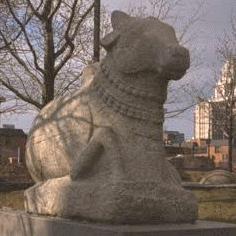
Nandi is the vehicle of Shiva: a white, humped bull. He is always portrayed in temples of Shiva, sometimes as anthropomorphic. His veneration is related to the general respect for cows in Hinduism. A sculpture of Nandi.
Page 73
[74]
padyatra
Pilgrimage undertaken on foot (Hindi). See below, p. 488 [502].
to Assam
Where they may be massacred. See above, p. 56 [57].
M G R
Marudur G. Ramachandran, Tamil Nadu's Ronald Reagan, who made numerous Robin Hood movies in which he defended the common man from various villains. As a result, he was, even before Ronald Reagan became President of the U.S., elected Chief Minister of Tamil Nadu in early 1980. He made "mythologicals" like the kind Gibreel Farishta stars in (note by Srinivas Aravamudan, see also Avramudan "Being God's Postman" 9).
N. T. Rama Rao
Starred in Hindu "mythologicals" (in the novel called "theologicals") and was elected head of Andhra Pradesh. (See Avramudan: "Being God's Postman" 9.)
Bachchan
Amitabh Bachchan, see note above, in Introduction.
Information on Bachchan.
Durga Khote
Brahmin film star whose appearance in Ayodhyecha Raja (1932) helped to legitimize respectable actresses performing in films. Before this time, female roles had been played by boys. Her politics were liberal, but anticommunist.More on Durga Khote.
Page 74
[76]
Fancy-a-Donald T-shirts
Warning: this is an "R-rated" note, minors and easily-offended persons should skip it. First a short lesson in Cockney rhyming slang. A word is rhymed with another word which is part of a word phrase, of which only the non-rhyming part is usually spoken. Clear? OK, here's a simple example: "head" rhymes with "bread," which is part of the phrase "loaf of bread;" so the word "loaf" comes to mean "head," as in the expression, "Use your loaf!" Another more racy example: "fart" becomes "rasberry tart" which leads to "razz." To "razz" people was originally to make a farting sound at them. In the present instance, in the question, "Fancy a fuck?" (American equivalent: "Wanna fuck?") "fuck" has been linked to "Donald Duck" and "Donald" substituted for the word. Print up a t-shirt with the words "Fancy a" followed by a picture of Donald Duck and a question mark, and you have a Fancy-a-Donald T-shirt of a cheerful vulgarity likely to appeal to the members of the Prospero Players who probably safely assume their fellow Indians at home will not get the joke. An English/Cockney Rhyming Slang Dictionary.
natyam dancers
Traditional Indian temple dancers who make a characteristic movement of their heads from side to side without turning their faces (Sanskrit, Hindi).
Benarsi saris
Saris in the style of Benares, or Varanasi, in Uttar Pradesh.
Page 75
'rail roko' demonstration
A type of protest in which railroad lines are blocked by the demonstrators (Hindi).
[77]
Mr Charles Darwin
The founder of modern evolutionary theory, rejected by Biblical literalists like Dumsday. Evolution: Theory and History. Joel Kuortti suggests Dumsday's first name, Eugene, may ironically refer to eugenics, systematic breeding which artificially imitates the process of evolution. See also note on Lamarck, above, p. 5.
Christian guard
Christian God: Dumsday (=doom, dumb) speaks with a thick Texas accent.
What characteristics of Dumsday do you think Rushdie considers peculiarly American?
Page 76
God-ridden
Haunted by thoughts of God. Darwin began his career as a theist, and wrestled for years with his doubts as the evidence against the existence of the Biblical Creator mounted. He was not, as fundamentalists like Dumsday often suppose, a dogmatic atheist whose evolutionary beliefs were designed to reinforce his skepticism; rather he tried repeatedly to accommodate religious sensibilities in his work.
Beelzebub
A traditional name for the devil (see, for instance, Matthew 10:25) (Hebrew). See note below on "Baal," p. 97 [100] and p. 167 [173], where the manticore calls Saladin "Beelzebub".
Asmodeus
A Hebrew demon featured in the deuterocanonical book of Tobit (3:8), associated in Jewish tradition as well with Solomon.
Lucifer
Isaiah 14:12 addresses the conquered king of Babylon as Lucifer "How art thou fallen from heaven, O Lucifer, son of the morning!" This verse was interpreted by early Christians as referring to Satan. The name originally refers to the planet we call Venus (see p. 131 [135]); but because of its use in this verse has come to be connected with the tradition of Satan's fall from Heaven. More information on Lucifer.
Rotary Club
International businessmen's organization founded in Chicago in 1905, promotes peace and community work. Generally viewed as a conservative organization which Rushdie presumes might welcome a speaker such as Dumsday. The Rotary International home page.
[78]
Vasco da Gama
Portuguese navigator, first European to sail around Cape Horn to find a sea route to Asia in 1498, was appointed Viceroy to India in 1524, but died and was buried only three months after he arrived, in Cochin, where Dumsday has just been speaking.
hashish
A drug made, like marijuana, of hemp.
Page 77
one hundred and eleven days
This prolonged ordeal is modeled on 1985 TWA hijacking discussed above in the note on p. 4.
What effect does it have on the novel that the hijackers are Indians? Discuss.
Shelley Long and Chevy Chase
The film would seem to be "Foul Play," a 1978 preposterous detective caper film invoving a plot to assassinate the Pope set in San Francisco, though Chevy Chase's costar was not Shelley Long, but Goldie Hawn. Information about the film.
Page 78
[79]
Dara Singh Buta Singh Man Singh
Sikhs are traditionally named "Singh." Several notorious incidents involving Sikh separatists had happened in the period preceding the publication of the novel, including the assassination of Indira Gandhi. The bandits' pseudonyms are taken from the following celebrities: Dara Singh is a wrestler turned movie star; Buta Singh is a prominent politician; Man Singh was a bandit who joined forces with Phoolan Devi (see note on Phoolan Devi, below, p. 263 [272]).
Tavleen
Tavleen Singh is a well-known journalist who writes about political issues.
the oasis of Al-Zamzam
Named after a famous spring; see note below on p. 91 [94].
Page 80
[82]
Hijras! Chootias!
Eunuchs! Fuckers! See note on "Amazonic Hijra," above, p. 54 [55] (Hindi, Urdu).
Page 81
[83]
funtoosh
Done (Hindi).
single unified force
See note on "unified field theory" above, on p. 24.
djellabah
A loose hooded gown, worn especially in North Africa (Arabic).
Page 82
[84]
Xixabangma Feng
Also known as Kao-seng-tsan-Feng (Gosainthan) and Shisha Pangma, located in Tibet. Most of the heights of these mountains recited by Chamcha differ slightly from later measurements, the last two are listed in the wrong order, and two are omitted from the sequence: Cho Oyu, 8153 meters and Lhotse, 8,501 meters (Kuortti). Peaks of the Himalayas.
Annapurna
This Nepalese mountain has several peaks,the highest of which is now believed to be slightly higher than the figure Gibreel recites. See Peaks of the Himalayas. Photos from the Annapurna circuit.
Chomolungma
Tibetan name of Mt. Everest, located in Nepal and Tibet.
K2
Also known as Mt. Godwin Austen, Dapsang, and Chogori, located in Pakistan.Information on K2.
Kanchenjunga
Also called Kangchenjunga and Kinchinjunga, or (in Nepali) Kumbhkaran or Lungur. Located in Nepal-Sikkim. A photo of Kanchenjunga.
Makalu
Also known as Kangshungtse. Located in Nepal and Tibet. Information and pictures.
Dhaulagiri
In Nepal. Information and pictures.
Manaslu
In Nepal. Information and picture.
Nanga Parbat
Located in the Indian part of Jammu & Kashmir. Photograph of Nanga Parbat. The Nanga Parbat Continental Dynamics Project.
Page 84
[86]
Dalai Lama
In Tibetan religious belief he is an incarnation of Avalokitesvara, the guardian bodhisattva of Tibet. When the current Dalai Lama dies, a new one is sought among recently born babies. The 14th one is Tenzin Gyatso (1937-), who received the Nobel Peace Prize in 1989; after the 1959 Chinese occupation of Tibet he was exiled in Dharamsala, Punjab, India, where he created an alternative democratic government (Kuortti). In The Court Of His Holiness The Dalai Lama.
Page 85
[86]
the Old Gramsci chestnut
Italian Marxist Antonio Gramsci (1891-1937). The closest thing to this quotation I have found is "The crisis consists precisely in the fact that the old is dying and the new cannot be born" (Gramsci 276). Rushdie comments, "So many variations of the phrase were common in the conversation of both Indian and British leftists that I felt free to describe it as an old chestnut. It may be less of a chestnut than I thought. . ." (personal communication from Salman Rushdie). Resources on Gramsci.
Page 86
[87]
shorn Sirdarji
Devout Sikhs never trim their beards or hair (Hindi).
Page 87
albatross
[88]
Reminiscent of the albatross in Samuel Taylor Coleridge's poem, "The Rime of the Ancient Mariner," which tells the story of a ship whose crew almost all died at sea, as the passengers of this jumbo jet are about to die. The Rime of the Ancient Mariner.
and the walls came tumbling down
Refrain of an old African-American spiritual by H.T. Burleigh retelling the story of Joshua's miraculous destruction of the city of Jericho (see Joshua 6). Since the story in the Bible is presented as a victory, the image is appropriate for the upbeat twist Rushdie gives the bombing. More information about Burleigh.
Next chapter
Back to Table of Contents