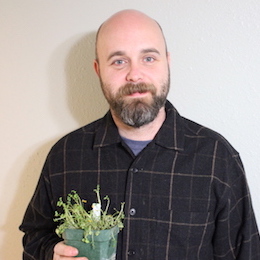
I am a PhD candidate studying the genetics of populations. My research is focused on understanding the factors that drive the transition from outcrossing to self compatibility. More broadly, I am interested in the interaction between the ecological drivers of diversity and adaptation.
As an undergraduate I decided to major in biology
after my first lesson on Hardy-Weinberg. The transfer of
information from one generation to the next has always
fascinated me. Without this exchange of genetic data,
evolution could not have produced the diversity of life we
see all around us. For this reason, I am particularly
interested in studying population genetics and the evolution
of systems of reproduction. Mating systems are particularly
interesting because they determine the mode of inheritance
and so have profound implications on the distribution of
genotype and allele frequencies in natural populations. In
addition, transitions in mating system tend to be commonly
observed in nature. A central objective in science is to
explain the underlying drivers responsible for these kinds
of repeated patterns.
Another area that I am particularly
interested in is using mathematical and simulation based
models to extend theory beyond equilibrium expectations.
Often evolutionary change is concentrated in the distant
past or occurs during rare events such as bottlenecks. This
provides both challenges and opportunities to build
evolutionary and population genetic models which act as
hypotheses that can then be challenged by data. My goal is
to use these approaches in combination with field
experiments to understand the evolution of populations.
Full Research Statement
My approach to teaching and mentoring is centered around the
belief that students must be able to make mistakes in order to learn.
Much of the craft of science is built around quantifying and describing
sources of error. I believe that to learn the scientific method students
must be encouraged to do more than simply learn facts by rote. By
allowing students to experience and understand sources of error I aim to
develop skills in problem solving and logic. These fundamental abilities
are foundational to any career.
Too often students are shown how a
puzzle was solved without learning the skills required to solve problems
for themselves. This is why I believe that scientific coursework needs
to include both mathematical and laboratory components.
Full Teaching Statement
ABO Blood Model
hub.wsu.edu/fer...
Chris Herlihy Lab
www.herlihylab.com
Handbook of Biological Statistics
www.biostathandbook.com/
Jeremiah Busch Lab
labs.wsu.edu/buschlab
Essential Reading List
mobile.twitter.com/...
Not Just a Theory: The Utility of Modeling
journals.plos.org/...
Numerical Recipes in C
www.nrbook.com/...
R in a Nutshell
proquest.safaribooksonline.com/...
Regular Expressions Intro
www.aivosto.com/...
Statistics for Biologists
www.nature.com/...
Wolfram Alpha
www.wolframalpha.com/
Published
Layman, N.C., Fernando, T.R., Herlihy, C.R., Busch, J.W. 2017. Costs of selfing prevent the spread of a
self-compatibility mutation that causes reproductive assurance. Evolution, 71:884-897. doi:10.1111/evo.13167
In Prep
Layman, N.C., Busch, J.W.. The Spread of Selfing in Polyploids. Target: American Naturalist
Layman, N.C., Busch, J.W.. Population-genetic expectations for ecological filtering and adaptive evolution of plant breeding systems on islands. Target: Evolution