Viburnum ×burkwoodii
Burkwood viburnum
- Water use: Moderate; tolerates some drought.
- Light: Full sun or partial shade.
- Size: 8 to 12 feet tall and more than half that wide.
- Origin: This shrub was created in England in 1924 by
crossing Viburnum
carlesii with Viburnum utile.
- Plant habit: Semi-evergreen, spring flowering, upright,
multistem,
woody shrub.
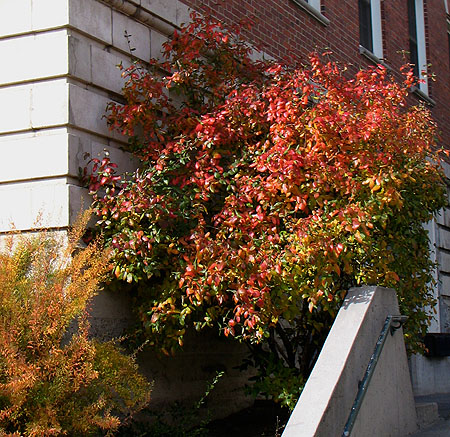
- Leaves:
Dark green leaves are shiny above. Fall color is orange and
red.
During mild winters, the leaves remain on the shrub. In Pullman
and
Moscow, most of the leaves fall off during most winters.
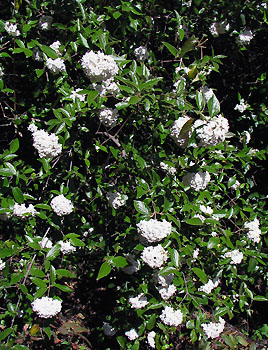
- Flowers: Blooms in spring. Flowers are pleasantly
fragrant.
The clusters of flowers resemble small snowballs. Flower buds are
dark pink and usually open to white. Some cultivars have been
selected
for redder buds and pink flowers.
- Fruit: Some plants form sparse clusters of small
fruit.
They begin red, then turn black in early fall.
- Culture: This shrub is easy to grow. It tolerates
heavy soils.
- Maintenance: This shrub can be slow to fill in, so it
often
looks
sparse when it is young. Pruning this shrub after flowering can
help
this.
Return to:
Water-conserving plant list
Shrubs
Page creators:
Virginia I. Lohr
and Caroline H. Pearson-Mims
Dept. of Hort &
LA, Washington St. Univ.
E-mail: pearson@wsu.edu
WSU's
Disclaimer
& Freedom of Expression Policy
Page updated July 30, 2008