introduction by Phuong Nguyen
return
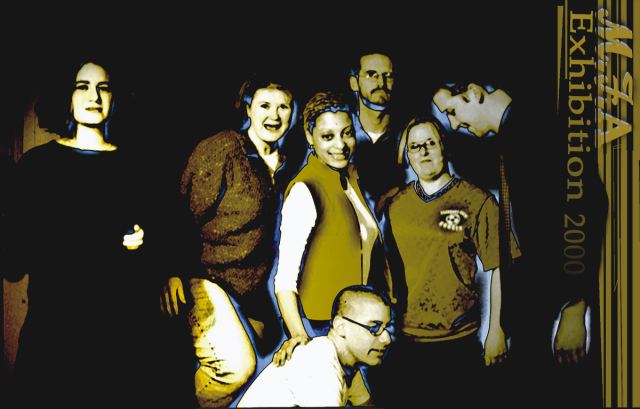
As a professor in the Fine Arts Department, I have had the opportunity to work closely with our M.F.A. graduates and have admired the interest this current group has taken in each other's work. This spirited engagement has assisted each of them in developing in unique directions, approaching their interests with commitment and honesty. It has also brought a heightened awareness of their artistic affinities and differences. In the current artistic climate where many people are concerned only with "art for art's sake" , all of these artists take the risk of working from the starting point of their own histories, psychology or current environment.
Employing photographic and digital imaging processes, Dane Webster uses personal narrative to examine the mechanics of myth building. Drawing on material from his upbringing in Mormonism, a religion whose past is understood as buried and recovered (literally dug up from the ground in the Book of Mormon), he is interested in the distortions of time which render memory mythical, allowing the attachment of symbol to image.
In her colorful ceramic pieces, Carolyn Ford creates her own humorous mythology. Drawing her outrageous style from Southern oral culture and Weekly World News headlines she presents a narrative of dogs conquering space. While joyfully reveling in the absurd, her narrative operates as a satire of the human conquest of space.
Like Webster and Ford, Megan Martens has an interest in the construction of belief systems, but she is preoccupied with their continual daily recreation, rather than their origins real or fictive. Her photo-based work, in the socially critical tradition of Realist painting is in examination of the forces that shape her hometown of Upton, Wyoming. In particular, she draws attention to the problematic power relations between people and animals and the ways in which these are held in place by rodeo pageantry and farming and hunting practices.
Paula Farmer is also interested in the representation of community; however, it is not the community of her youth hut the one she now finds herself in - that of African-American women here in Washington State University.
Using photography, video and installation, Paula seeks to describe the community, as it is understood from within and to question how it is seen from without. Rather than privileging the singular voice of the artist, Paula's work seeks to create a more complex story hy incorporating audio and video interviews as well as photographs taken hy others.
While some of his fellow artists seek to describe their social settings, past and present. Brian Simko is more interested in his physical surroundings. Using antiquated technologies of viewing, several of which employ stereoscopy to heighten awareness of one's placement in three-dimensional space, Simko explores the claustrophobic spaces of prefabricated architecture. Through pieces that require participation, he invites the viewer to examine the uneasy psychology of peepholes and endless hallways.
Michelle Melancon is also concerned with the viewer's relationship to strange spaces. Similar to theater sets, her mixed media installations evoke an underwater environment that must be navigated by the visitor. These floating ocean worlds can also seem sinister. Her delicate paper diving suits become a metaphor for the fragile mental barrier constructed between the individual and a frightening world; a barrier often formed hy art.
John Jenkins, rather than depicting a relationship with the outside environment, instead explores his own connection to the fictive space of painting itself. He combines multiple figures and picture planes to create and recreate versions of himself through painting. These repetitions take on the character of a game or joke, both of which expose the rules of discourse yet purposefully frustrate the viewer's search for truth or meaning. The recurring image of headphones suggests that these paradoxical creations reflect the logic of Jenkins' interior world.
I hope that visitors to the museum will enjoy their engagernent with the work of these seven fine artists as much as I have. While they pursue very different strategies and interests, they share a commitment to art as a method for investigating ideas.
Phuong Nguyen
Assistatnt Professor of Art
Department of Fine Arts
Washington State University
