An article last year in the Idaho Spokesman-Review noted that businesses in the inland northwest are increasingly concerned that public high schools in the region aren't providing their students with the skills necessary to be good workers. As a result the Coeur d'Alene school district was planning to replace a number of now irrelevant classes, including world history, reading, English literature and geography, with more "career oriented" courses such as technical manual writing. School teachers were even encouraged to spend their summer vacations working in local businesses, like McDonald's restaurants, in order to better understand the kinds of skills that employers need in their workers.
In an era in which "education" is increasingly made subservient to the demands of the corporate sector, and in which universities are under growing pressure to function as research fiefdoms for private industry, the decision to attend graduate school in the fine arts is not one that is taken lightly. The students who travel to Washington State University's MFA program from across the United States, and from around the world, have made a conscious choice to embrace the increasingly embattled belief that education can be something more than vocational training; that it can provide an opportunity to expand the boundaries of one's consciousness, to literally think differently (about yourself and about the world around you).
WSU has been fortunate enough to attract a remarkable group of students to its graduate program, with many different life experiences and backgrounds; students who express a diverse range of interests and concerns in their art. All are united, however, by their faith that art, despite the economic risks involved, is a worthwhile pursuit and that it constitutes a unique and valid way to understand the world. The Mexican artist and social activist Felipe Ehrenberg has coined the phrase "Art is an Excuse...". Ehrenberg doesn't mean by this that art is a way to run away from more "serious" problems or a pretext to luxuriate in the privileged subjectivity of the creative genius. Rather, he is pointing to the fact that art provides an opening onto the cultural and social world, a point of access that is, for various historical reasons, understood to be at least nominally open.
For Ehrenberg art is (at least partially) a "free space," from which it is possible to challenge an increasingly monolithic and market-driven commercial culture. Art provides a space in which to do and to say and to know things that the managers of MacDonald's restaurants and the Coeur d'Alene school district don't necessarily want us to know. Art is, or can be, capable of challenging received wisdom, of transgressing the limitations of disciplinary knowledge, and of bringing our attention to the often hidden significance of material and physical experience. With this freedom, this license, comes a sense of obligation. From Courbet to Hoch, and from Gericault to Holzer, artists have consistently sought to use the space of art to encourage openness and critical inquiry and to challenge arbitrary and capricious forms of authority.
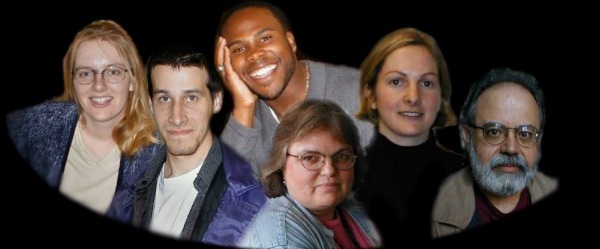
The graduating students in this class are no exception to this tradition. Hasaan Kirkland's paintings offer a vivid symbolic expression of his commitment to African and African-American culture. In a region of the country marked by quite recent manifestations of racial hatred and ignorance Kirkland's images are both uplifting and courageous. His work speaks not only to black viewers but to all who recognize the great loss that has been suffered in western culture and art history through the systematic exclusion of black voices and images. Elizabeth Obert's photographic collages explore the construction of identity through the device of the mask or veil. She challenges a visual culture obsessed with exposure and revelation (especially of the female body) with images that deliberately deny or suppress the viewer's inquiring gaze. Her work marks out the complex and contradictory functions of the veil for as both a form of protection (that is at the same time seen as an incitement to look), and a form of repression, in which women are denied the freedom to define their own bodies as anything other than fodder for male desire.
Peggy Sue McRae's stone carvings mark her own act of resistance against the incessant demand that art must compete with the jangling blandishments of a hyper-accelerated consumer culture. For the maker as well as the viewer these pieces impose a form of contemplation that is meditative and almost ritualistic. These pieces are very much related to McRae's own spirituality and her deep commitment as both an activist and an artist, to the sanctity of the life force of the earth and of woman's complex relationship to nature. Mitch Cope, perhaps drawing on some buried temporal memory from his childhood in Detroit, also encourages us to view time differently. His assemblage pieces challenge the myth of the object d'art which staves off the inevitable forces of history and entropy by withdrawing behind a perfect, finished surface. Cope's works suggest the extent to which an aesthetic response is dependent on the mise en scene of the gallery and museum, as he asks us to consider the potential beauty in the detritus of the urban and industrial decay. In some cases Cope re-deposits these accumulations back into the environment from which they came to be re-absorbed by corrosion and decay and, perhaps, to be discovered by passersby as strange signs of an unknown intelligence.
Jesse Bukrey's installation examines the human/animal relationship in the midst of a school that has been "built on the backs of" animals (to use an image from Andrew Leicester's COBUMORA sculpture at the WSU Vet School). Bukrey's Rattusroom installation challenges the purity of art by bringing the repressed figure of the rat (simultaneously reviled and instrumentalized by human society) into her work. Bukrey seeks to define a possible "hidden connection" between the souls of animals and humans in her work. Although she shares Cope's fascination with the aesthetic appearance of decay her interest in it is perhaps more related to her resistance to cultural fears of the organic body and the inevitability of death. Finally, Marc Steine's biomorphic sculptural forms are intended to be both physically and conceptually ambiguous, confusing our tendency to seek out reassurance from the world around us through the projection of familiar categorical grids. Steine offers us instead troubling "Rorschach tests" that change both form and meaning as the viewer moves around them. All these artists are engaged with challenging the bodily spaces and forms of knowledge that we associate with modern life; the abstraction, the relentless speeding up of time and productivity, the blind embrace of progress and technology over the quality of lived experience, the derogation of cultural difference on behalf of a mythic whiteness, and the self-confident and misguided assertion of our mastery of over the unknown and perhaps unknowable mystery of the world around us.
Grant H. Kester
Assistant Professor, art history
Fine Arts Department
Washington State University