MFA THESIS,1997
CATALOG OF THE EXHIBITION
introduction by Nathan Griffith, Ph.D.
index
INTRODUCTION
Art is art. Everything else is everything else.
- Ad Reinhardt, 1958
And so it goes. But the fact of the matter is that art is never only art. It has a time and a place, a maker and an audience. Beyond that, all bets are off. What we make of art is bound to the moment and to the experience, it is bound to who we are and what we have seen. And so it goes.
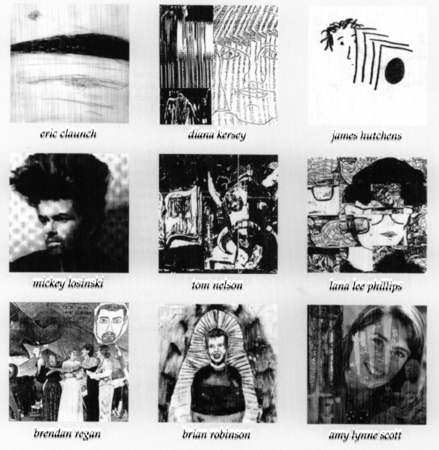
In 1995, nine souls came together, in this place, a town called Pullman, and a home at WSU. There was Brian (Timmy) Robinson. He came from Nashville. With him he brought his wife Jennifer, a Delta 88, Elvis, and a head full of memories. There was Lana Lee Phillips. She had been here for a while. She knows the land and its peoples. Her dreams began in the wheat fields of the Palouse. From the east came Brendan Regan. He is bound to his Irish heritage and his Catholic guilt. There was Amy Scott, a horne-grown Washington Woman. She sees the future and sometimes it scares her. And there is James Hutchens and Tom Nelson. They came with the others, but they will remain. Their stories have yet to be told. Eric Claunch arrived, a man who came from nowhere in particular, strong and silent with a heart of gold. He was on a search for the truth in art. There was Mickey Losinski. Mickey brought with him the elements of curiosity and mutability. He had a pink car. Finally, there was Diana Kersey from Texas. Diana had the devil in her, a truckload of clay and a head full of ideas.
I speak as if they are gone. They are not, at least not yet. They will remain in spirit, the spirit of the art that they have made here, the ties that they have forged, and the lives that they have forever changed through their vision.
But, what of this vision, their art, those objects and ideas that came to fruition in their short stay here? It is difficult to say just what binds these souls together. It is certainly not a matter of style or material, not a motif or a philosophy. It might be said that it is nothing more than a happy accident, through the occurrence of which might be read a certain critical and historical discourse.
Lets go back to the beginning. Art is art. Art is what these people do, the nine souls of which I speak. Art is life, the lives of the persons here who make it and of those who see it made. This art has a history.
For Diana Kersey, history is marked through the objects in her past and through herself. A basketba11 becomes pure form. It is riddled with spikes and burned to a crisp. It is multiplied by nine. A shadow is etched on brick and mounted on a wall. The trace of feet on floor ground the identity of the shadow. Kersey constructs her image from the stuff of the earth, the adobe and the iron, the minerals that etch color into the surface. She reminds us of her past as one who has lived close to the earth and will always remain.
This notion is shared by Amy Scott. She too is bound to the earth. Yet, her vision is different from that of Kersey. Her reverence for Gaia takes place through a translation of nature by the mechanisms of culture: technology, the word, religion, and philosophy. By Scott, the image is captured through the digital and the means of hand, paint, and brush. Through the organic, by the brush, she pictures a field, an ephemera of color, textures, and surface through which can be read a feeling: the spirit of creation, destruction, and harmony. Bound to the surface are signs which speak of culture: the spiral which at once denotes chaos and the coming together of energies, the cycladic woman who marks humanity's relationship to the world. The field these images create is a counterpoint to the technologies which she engages. The computer becomes the site for an anti-narrative, a discursive collection of sound and vision, a conflation of image and text, which appears to have a beginning, but no real middle or end. It is a treatise about the instability inherent to the coupling of technology and nature.
Instability is a hinge point in the works of Brian Robinson. However, the instability which he pictures is one of the self, the unstable identity formed in and through history, a personal history, his own. Robinson paints. He paints signs. He paints the body, his body. The subtext of his work is the layer as it implies the passage of time and the multiplicity of meaning. The fact of the layer and the picturing of the body come together as catharsis and ecstasy when signs: the limb-less torso, the toothy grin, and the dummy's head congeal as the powerless body seeks deliverance from the mark of the teeth, the gnashingof the flesh through the vehicle of dislocation in the guise of the alter-ego. The paint itself marks history through time, the time of making. The layers are applied one upon another, seeping through, hiding out under the cover of the glaze. They mark time through the form of the wound: as it is newly brought upon the body, in its healing, through its disappearance in the perpetual regeneration of the flesh.
Flesh marks the body as it is conveyed through the gesture. It has become Mickey Losinski's role to make the gesture count for the history of the body, many bodies that converge upon a site. Each body, or should I say figure, counts for a person. Its origins are in the clothes of that person and in the gesture of the form. The form is sculpted from plaster. In its making are lost the parts: the face, hands and feet, the bulk of the torso; those features by which we read identity, through which we name those around us. Losinski relies upon the gesture as figures come together to form a group, a heterogeneous amalgamation of characters that fashion a basic societal unit. And in their installation, we are left alone with that group to reconcile our place among them, to find ourselves captured through the gesture as a record of a moment in time.
The gesture is transposed from body to mind in the works of Claunch as he contemplates the essence of perception as a vehicle through which to mark experience and construct a personal history of the world. That gesture takes form in the mark, be it of paint or ink. He is involved in a questioning, a coming to terms with the means by which we endeavor to know. He constructs a record of experience, the experience of a single place over a period of time. Each day for a month he makes a series of marks. The marks convey the remnants of this place, from one time to the next. In their synthesis, their translation from drawing to print, the marks are refined, redefined in a literal conflation of the image and the memory of its making.
As with Claunch, the notion of memory permeates the works of Lana Phillips. It is, however, through the recombination of memory that her paintings convey the mechanics of thought as the convergence of disparate elements compiled from the whole of one's persona1 experience. This takes form in the act of painting and through the mechanism of weaving. In producing the woven grid, separate paintings are combined as a metaphor for the integration of one memory or impression with another. The end result is a rearticulation of the visual world as a series of perceptual events which overlap one another in the course of their conceptualization by the rational mind. As such, a tension is developed when recognition of two separate and coherent thoughts (conveyed by the metaphor of the visual image) is disrupted by the breakdown of readability. Through this disruption, the history of each visual event is negated and the component image produced stands instead for the fallibility of memory when faced with the postmodern quandary of over- stimulation.
Finally, it is through the work of Brendan Regan that all of the tendencies cited heretofore coalesce. Over-stimulation seems to be the essence of his work, both in a literal and figurative sense. He takes coffee as his motif: the bean, the beverage, its history, and the very fact of its overwhelming role in contemporary American culture. The reality of the bean is translated through the apparatus of installation. A shrine is constructed from the remnants of the coffee experience, the cup which holds the beverage and the beans which are placed upon the shrine. The beans function as sacrament, the flesh of the gods, the wine and host at once. On this shrine stands an icon, the goat, serving both as sacred symbol for the mythology of the bean and as a record of the historical moment of the its discovery. This shrine is set within a space and in this space there is the image, multiple images, photographs of the cafes and coffee houses, the roasters and the restaurants, the locations through which the sacrament is distributed, the spaces which are marked as holy by devotees of the substance. In this space the aroma of the bean is overwhelming. This aroma is the sensory mark of its experience. It is combined with the signs of shrine and image to make a conceptual framework through which we comprehend the power of this object, this substance, the coffee bean.
And so it goes. What we take from this moment, the experience in time which is the witnessing of this exhibition; what we take is an idea, an understanding that art is never only art. For each of the seven souls represented here, it is something more, much more. It is a translation of their experience in the world through the mechanism of each one's unique personal history. What we make of this art is bound to the moment and to our experience. It is bound to who we are and what we have seen. And so it goes.
- Nathan Griffith, Ph.D.
Professor of Art History, Washington State University
ACKNOWLEDGMENTS
Special Thanks
To These Or anizations
for funding the
1997 MFA Catalogue
Private Contributors
Department of Fine Arts
Fran Ho
Graduate Professional Student Association
The Compton Union Building
The Dean of Liberal Arts
The Graduate School
The Office of the Provost
Linda Randall
WSU Museum of Art
Catalogue Printed By:
University Printing and Publications
Thomas H.Sanders, Director of Publications
and Printing WSU Press
Catalog Designed By: Amy Lynne Scott
Photography By: Brendan Regan
return