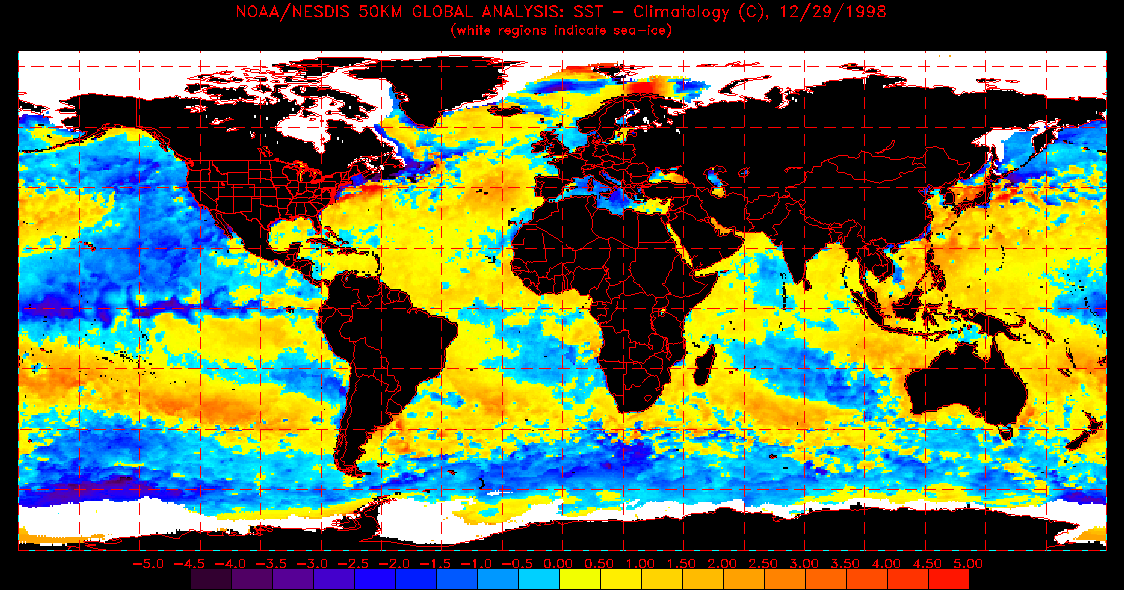
Why do changes in the position of atmospheric pressure systems create major disruptions in marine life? The atmosphere and ocean are strongly linked. Atmospheric pressure drives surface winds, which in turn drive the ocean circulation. The strong effects that changes in ocean circulation patterns have on marine life is dramatically demonstrated by a periodic disruption called the ENSO phenomenon (El Nino/ Southern Oscillation). In this assignment, your goal is to study how these changes in pressure (Southern Oscillation) and winds create the El Nino effects on marine ecology. (Note: El Nino is also known for extreme weather events and ecological disruption land, affecting the entire world. For this assignment, we will focus on the effects of ocean currents and their disruption on ocean conditions and on marine life.)
There are two parts to the following assignment. You will first follow a specific example of a strong El Nino cycle (1997-1998) and describe the sequence of events. Examine the causes of the ENSO cycle and the effect this cycle has on physical oceanography in the Pacific Ocean, including changes in sea surface temperatures, wind speeds and directions, currents, and the thermocline. In the second part of the assignment, you will explore the consequences of the ENSO cycle on marine life. Do not limit yourself by the questions asked in part 2, but rather, use these as a platform to begin searching for answers about the effects of ENSO on the marine realm. From the knowledge you gain during this exercise, deduce the state of the Pacific Ocean today. Is an ENSO cycle occurring right now? What evidence can you cite? Use resources on internet web pages linked below to write about the ENSO ocean current anomaly.
Part 1
Summarize the ocean conditions during the El Nino/Southern Oscillation cycle. We will use the 1997-1998 El Nino cycle as an example. Use the following links to answer the questions below.
How are the tradewinds altered during ENSO? To understand the alteration of tradewinds, it is first important to describe their natural progression. What is the pattern of the tradewinds during normal years?
Tradewinds in the Pacific Ocean
Compare these average vectors to the direction of tradewinds during the 1997-1998 cycle. How do the direction changes of the tradewinds correspond to the changes in SST (sea surface temperature)?
How does the distribution of warm surface water progress throughout the ENSO cycle from January 1997 - March 1998? How does the size, depth and location of the thermocline evolve during this same time period? What happens to the height of the sea surface? Take a look at the tempeature anomalies in the second set of graphs to describe how water temperatures in the Pacific Ocean differ during strong El Nino years when compared to normal years. Now examine the last two graphs on the page. What are typical sea surface temperature and height patterns? How are these both altered during El Nino years?
What is La Nina? How do the tradewinds, currents, and SSTs change during this time period? The following link provides useful background information on La Nina. You may also want to refer back to the graphs linked above to help in answering these questions.
Describe the progression of sea surface temperature (SST) and winds.
Use the following TAO web site to view these changes from Fall 1997 through
the present.
What is happening to ocean currents and sea surface temperatures?
Click on "Data Display." Play around with the various plots and animation buttons at the top of the page.
For a specific example, from the "Animation" section, "Select animation"
as follows: "TAO Monthly SST and Wind." You can step through the dates
using
the forward button.
For another specific example, "Select animation" called "3-D TAO Temp
and Dyn Height" and watch how temperatures change with depth. Note also
how sea level
rises as warm water gets warmer during the El Nino event that is evolving
in the Pacific Ocean right now.
Now that the basic physical oceanographic changes that occur during ENSO are understood, we can further investigate changes in Pacific oceanic life. Feel free to explore the effects of ENSO on the marine realm, paying particular attention to upwelling and primary productivity, the distribution and abundance of planktonic animals, and fisheries and marine vertebrates. The following links should provide some very useful information.
National Oceanographic and Atmospheric Administration sites:
NOAA
ENSO Homepage
ENSO
Cycle primer
ENSO
FAQ
ENSO
Impacts
NOVA PBS series site:
Nova El Nino homepage
El Nino Origins
Check
this plot, and then see the associated article
Warm water temperature map
Writing your report:
Your report should be in the form of a term research paper. When information is derived from a published source or web page, you need to cite that work (proper citation for web pages is given below). Comprehension of the issues and care in writing, not length of the report, will be the criteria for grading. Demonstrate a thorough understanding of the ocean currents and their causes. Focus on the effects on marine plants and animals. The questions in part 1 and 2 above should guide the emphasis in your report. The quality and clarity of your descriptions, and overall organization will be other important criteria in grading.
It is fine to work in groups during the research phase of this project. However, remember to write your reports individually. A type-written report is prefered. Three to five pages should be sufficient space.
The proper format for citing material from the web is given below. It is important that you use this format.
Author's Last Name, First Name. "Title of Document."
Title of Complete Work [if applicable].
Version or File Number [if applicable].
Document date or date of last revision [if different from access date].
Protocol and address, access path or directories (date of access).
EXAMPLE (for WWW pages):
Burka, Lauren P. "A Hypertext History of Multi-User
Dimensions." MUD History. 1993.
http://www.utopia.com/talent/lpb/muddex/essay
(2 Aug. 1996).
The reports will be due September 20 at the beginning of class.

